Faces and marks#
A pose moves the body. This chapter is about the face, and about what a comic draws around a character rather than on them: sweat flying off a head, stars circling a dizzy one, the scribble that stands in for an oath.
What you will make#

Four panels of one story: Alice sweats while Bob asks for his umbrella, swears when it comes up, spins as she explains, and is left surprised when Bob storms off in a cloud of dust.
Expressions#
expression chooses a face the puppet
declares, by name, as pose chooses a set of joint angles. The shipped puppets have ten:
neutral, happy, laughing, sad, angry, shouting, surprise, scared, coy and
bored. They are a drawing convention, the small closed set of faces comics actually draw.
# Ten expressions, which is every face the shipped puppets can make.
#
# An expression is to features what a pose is to joints: the puppet declares feature
# points that ride the head, declares named expressions as a state per feature, and the
# panel selects one by name. Nothing here touches the solver -- a face is still one disc
# that balloons may not cover, exactly as it was.
#
# The vocabulary is Comic Chat's emotion wheel plus `surprise`, which is to say it is a
# **drawing convention**: the small closed set of faces comics actually draw. It is not
# a claim that a person feeling anger produces this face.
#
# Watch the pupils. `looking_at` has always turned a figure toward its target and made
# the space in front of them expensive for a balloon; now it aims their eyes as well.

camera:
  shot: medium_shot

cast:
  alice: {reference: alice, pose: arms_crossed, at: left_third}
  bob:   {reference: bob,   pose: hands_on_hips, at: right_third, facing: left}

staging:
  - alice left_of bob
  - alice ground_shared_with bob
  - alice looking_at bob
  - bob looking_at alice

panels:
  confrontation:
    cast:
      alice: {expression: angry}
      bob:   {expression: shouting}

  surprised:
    cast:
      alice: {expression: neutral}
      bob:   {expression: surprise}

  delighted:
    cast:
      alice: {expression: happy}
      bob:   {expression: laughing}

  unimpressed:
    cast:
      alice: {expression: coy}
      bob:   {expression: bored}

  afraid:
    cast:
      alice: {expression: sad}
      bob:   {expression: scared}
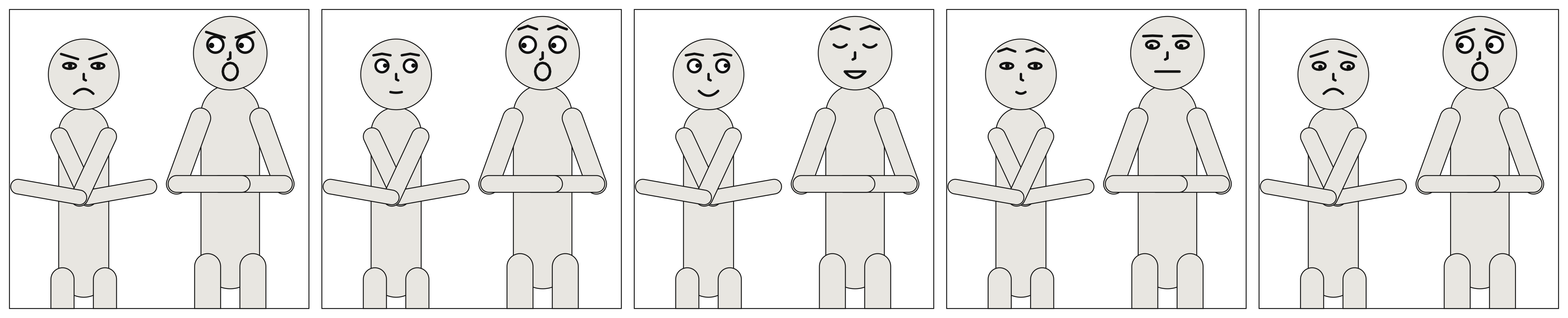
Each panel under panels: changes only the two expressions; the cast, the staging and the
camera are written once, beside panels:, for all five. Watch the pupils too:
looking_at aims the eyes as well as turning the figure.
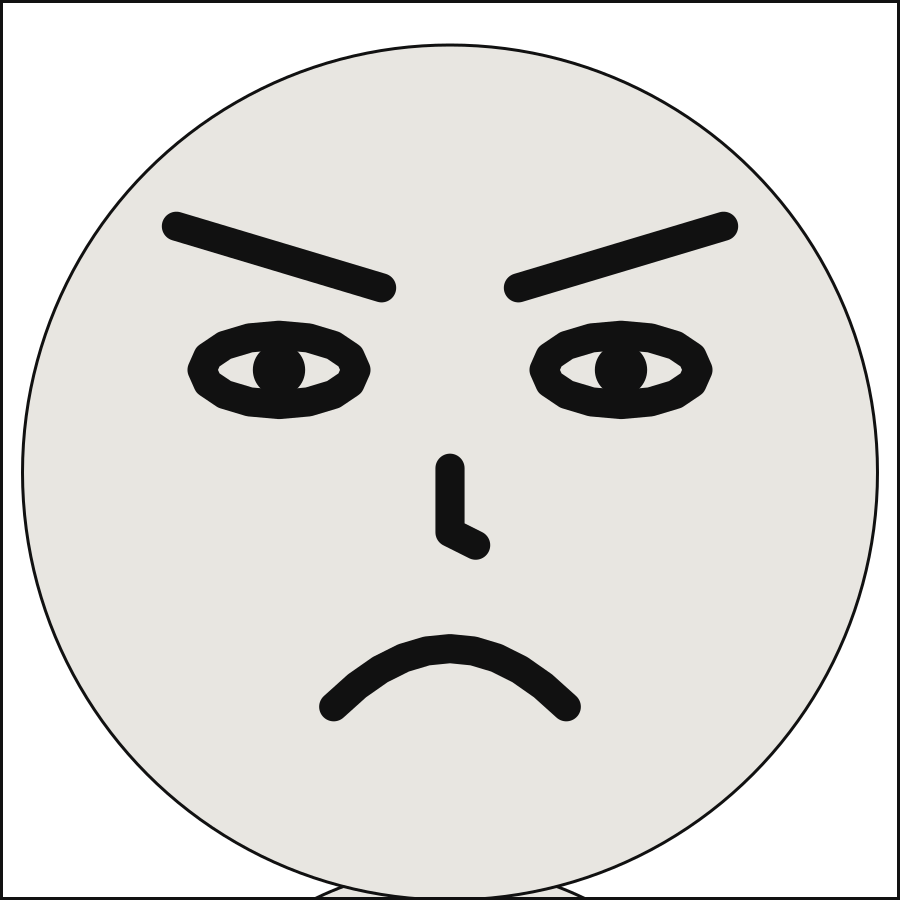
A face is worth a big close-up, the framing at which the head fills the panel:
# A big close-up, which is the framing that pays for the face rig: the head fills the
# panel, and until expressions existed it was a circle.
#
# One character on purpose. A big close-up of two is not a big close-up for long -- the
# camera retreats to fit them both across the panel, and the note it prints says so.

panel:
  size: [900, 900]

camera:
  shot: big_close_up

cast:
  alice: {reference: alice, expression: angry}

# No lettering. At this framing the head fills the panel and there is nowhere a balloon
# could sit without covering the face, which the compiler refuses to do -- and a silent
# reaction panel is what a letterer would have drawn here anyway.
Marks#
marks are emanata: what a comic draws around a
character. Mort Walker named them, and four of his names are the vocabulary:
Mark |
What it shows |
|---|---|
|
sweat flying off a head |
|
stars circling a dizzy one |
|
the scribble that stands in for an oath |
|
the dust somebody leaves behind |
They are a list, not a second expression, because they compose: Alice can be scared and sweating. Save the scene at the top of this chapter:
# Emanata: what a comic draws around a character, rather than on them.
#
# Mort Walker named them in The Lexicon of Comicana, and four of his names are the
# vocabulary: `plewds` fly off a sweating head, `squeans` circle a dizzy one,
# `grawlixes` stand in for an oath, and `briffits` are the dust somebody leaves behind.
#
# They are a list, not a second `expression:`, because they compose -- Alice is scared
# *and* sweating, angry *and* swearing.
#
# Unlike a face, they are drawn outside the head, in the space balloons go, so they
# matter to the layout. How much is the decision this example shows: a balloon pays to
# cover them, so in `oath` Alice's line settles beside her grawlixes rather than on
# them. But they never move anybody. Strip every mark from this file and both
# characters stand exactly where they stand now.
#
# That cuts both ways. The camera frames by the body and makes no room for marks, so
# over the taller character's head, at this framing, they would run off the top of the
# panel -- which is why they are on Alice. Try them on Bob: `scenet build` says so, as
# the example "Marks cut off" shows.

panel:
  size: [1000, 700]

camera:
  shot: medium_shot

cast:
  alice: {reference: alice, at: left_third}
  bob:   {reference: bob,   pose: arms_crossed, at: right_third, facing: left}

staging:
  - alice left_of bob
  - alice ground_shared_with bob
  - alice looking_at bob
  - bob looking_at alice

panels:
  heat:
    cast:
      alice: {expression: scared, marks: [plewds]}
      bob:   {expression: angry}
    script:
      - say: {by: bob, text: "Where is my umbrella?"}

  oath:
    over: heat
    cast:
      alice: {expression: angry, marks: [grawlixes]}
    script:
      - say: {by: alice, text: "It was hideous!", prefer: top_left}

  dizzy:
    over: heat
    cast:
      alice: {expression: sad, marks: [squeans]}
      bob:   {expression: bored}
    script:
      - say: {by: alice, text: "I spun it round. Very fast. Then it was gone."}

  gone:
    camera: {shot: full_shot}
    cast:
      alice: {expression: surprise}
      bob:   {pose: pointing, expression: shouting, marks: [briffits], facing: right}
    staging:
      - alice left_of bob
      - alice ground_shared_with bob
    script:
      - say: {by: alice, text: "Bob?"}
scenet build marks.scene.yaml --strip
wrote marks.heat.svg
wrote marks.oath.svg
wrote marks.dizzy.svg
wrote marks.gone.svg
wrote marks.strip.svg
Three of the panels are written over: heat: each takes everything from heat and states
only what changes. Chapter 7 is about over.
What the compiler decided#
A face is a disc no balloon covers. Whatever the expression, the face is the same disc to the layout, and no balloon, caption or sound may sit on it. That is why the big close-up has no lettering: at that framing the head fills the panel, and there is nowhere a balloon could go. A silent reaction panel is what a letterer would draw there anyway.
Marks matter to the layout, but move nobody. Marks are drawn outside the head, where
balloons go, so a balloon pays to cover them: in oath, Alice’s line settles beside her
grawlixes rather than on them. But strip every mark from the file and both characters
stand exactly where they stand now.
The camera makes no room for marks. It frames the body. Over the taller character’s
head, at this framing, the marks would run off the top of the panel, which is why they are
on Alice. Put them on Bob and scenet build says so, in a
cropped-marks note. A frame that cuts across
a speaker’s mouth gives a cropped-mouth note.
An expression the puppet does not have is an error. smirking is not one of the ten,
and scenet check says
unknown-expression, with the ones there
are:
cast:
  alice: {reference: alice, expression: smirking}
Try it#
Ten expressions: swap Alice’s and Bob’s expressions in each panel.
A face: try each of the ten expressions at a big close-up.
Emanata: the scene you built. Move the
plewdsto Bob, and read the note.
Check it#
scenet check expressions.scene.yaml marks.scene.yaml
expressions.scene.yaml: ok
marks.scene.yaml: ok
check looks every pose and expression up in the puppet that plays the part, so a face a
puppet lacks is found without drawing anything.
What you learned#
expressionchooses one of the faces a puppet declares, by name: the shipped puppets have ten.marksdraws emanata round a character, as a list:plewds,squeans,grawlixes,briffits.A face is a disc no lettering may cover, whatever it shows. Marks are avoided, but move nobody, and the camera makes no room for them.
Where to go next#
The next chapter, Setting and colour: what is behind the cast.
Add your own character, for a puppet with faces of its own, which chapter 10 builds.
The cards for
cast.<id>.expressionandcast.<id>.marks.