Sequences#
A comic is panels that follow one another, and consecutive panels share nearly everything: the same people, the same place, the same staging. A scene document writes what they share once and each panel’s difference on its own. You have read several scenes already; this chapter takes one apart.
What you will make#
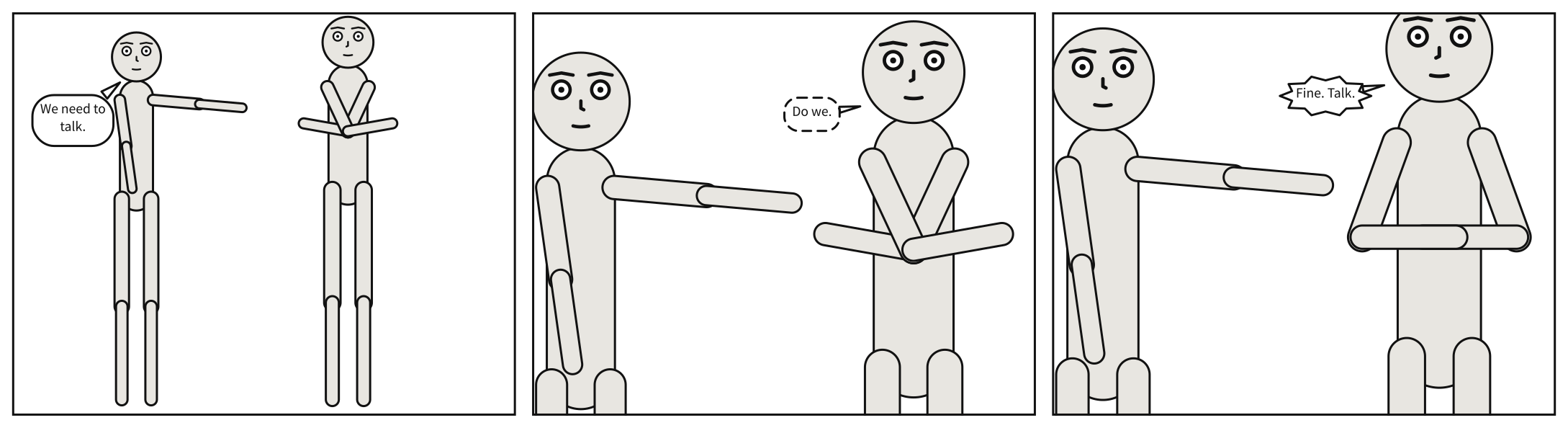
Three panels, each closer than the one before. Alice says they need to talk; Bob, in a medium close-up, whispers “Do we.”; then, at a close-up from a low angle, his hands on his hips, he shouts “Fine. Talk.”
A scene, panel by panel#
A scene’s panels maps a name to each panel, in
reading order. Every key a panel can hold may also be written beside panels:, as a default
every panel inherits. A panel may also inherit from another one, by naming it in
over, and state only what differs.
# Consecutive panels share nearly everything. `over:` names a parent and states only
# the difference -- borrowed from OpenUSD composition arcs, where it means exactly
# this.
#
# Mappings merge recursively; lists replace wholesale. Anything alongside `panels:` is
# a default every panel inherits.

panel: {size: [700, 560]}

cast:
  alice: {reference: alice, pose: pointing,     at: left_third}
  bob:   {reference: bob,   pose: arms_crossed, at: right_third, facing: left}

staging:
  - alice left_of bob
  - alice ground_shared_with bob

panels:
  establishing:
    camera: {shot: full_shot}
    script:
      - say: {by: alice, text: "We need to talk."}

  reaction:
    over: establishing
    camera: {shot: medium_close_up}
    script:
      - say: {by: bob, text: "Do we.", kind: whisper}

  closer:
    over: reaction
    camera: {shot: close_up, angle: low}
    cast:
      bob: {pose: hands_on_hips}
    script:
      - say: {by: bob, text: "Fine. Talk.", kind: shout}
scenet build talk.scene.yaml --strip
wrote talk.establishing.svg
wrote talk.reaction.svg
wrote talk.closer.svg
wrote talk.strip.svg
note: reaction: camera retreated to 54% of the requested 'medium_close_up' framing so the cast would fit across the panel
note: closer: camera retreated to 35% of the requested 'close_up' framing so the cast would fit across the panel
Each panel is an SVG of its own, named after the document and the panel. --strip adds
talk.strip.svg, every panel side by side in reading order, as above: a strip.
What a panel inherits#
A panel is built in layers, and the later layer wins:
what is written beside
panels:;the panel it is
over, which was itself built the same way;what the panel writes itself.
Within that, mappings merge and lists replace. closer writes cast: {bob: {pose: hands_on_hips}}: Bob keeps his puppet, his place and his facing from reaction, and only
his pose changes; Alice is untouched. But a list is replaced whole: a panel that writes
staging: or script: writes all of it. That is why reaction has only Bob’s line, not
Alice’s as well.
Leaving something out#
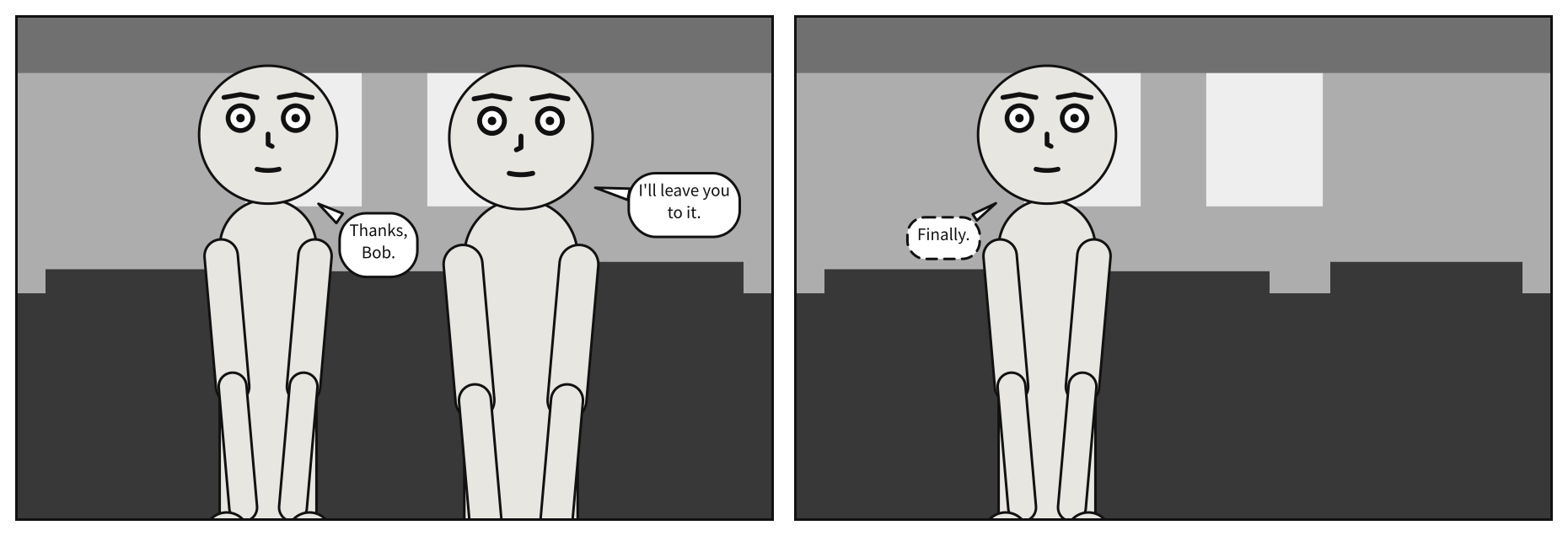
null takes away something a panel would inherit. Here Bob leaves, and the second panel is
over the first with bob: null:
# Leaving someone out of a panel that would inherit them.
#
# Everything beside `panels:` is a default every panel takes, and a panel `over:` another
# takes all of it. To take something away, write it as `null`: JSON Merge Patch's rule.
# Here Bob leaves, and `cast: {bob: null}` leaves him out of the last panel.
#
# A staging relation naming him would go with him, and `scenet check` would note it, as
# the example "A relation left out" shows. This scene places its cast with `at:` alone, so
# there is none to lose.

panel: {size: [900, 600]}
camera: {shot: medium_shot}
setting: {place: office, time: day}

cast:
  alice: {reference: alice, at: left_third}
  bob:   {reference: bob,   at: right_third, facing: left}

panels:
  meeting:
    script:
      - say: {by: bob, text: "I'll leave you to it."}
      - say: {by: alice, text: "Thanks, Bob."}

  alone:
    over: meeting
    cast:
      bob: null
    script:
      - say: {by: alice, text: "Finally.", kind: whisper}
null works on any key: camera: null drops an inherited camera, place: null an
inherited place. Chapter 10 uses both.
What the compiler decided#
Each panel has its own camera. The three panels are framed separately, each at its own
shot. Each asks for a tighter one, but both characters are still in the frame, and two people
do not fit side by side in a close-up: the camera steps back, further each time. A note in
a scene names its panel, so you can tell which camera moved and by how much. Take Alice out
of reaction, as the next section shows how, and its camera no longer needs to.
Inheritance happens before anything is placed. The compiler first writes out each panel
in full, as if you had typed every key, then compiles each one like a .panel.yaml. A
panel cannot tell whether a key was written or inherited.
A panel can only be over one that exists. over: reacton, misspelled, is
composition, with the panels there are. A panel
that inherits a relation about somebody it took away gives a
dropped-relation note, and the relation is
dropped with them:
cast:
  alice: {reference: alice}
panels:
  first: {}
  second: {over: frist}
Try it#
A sequence: the scene you built. Add a fourth panel,
over: closer, at an extreme close-up.Leaving someone out: give the second panel
camera: {shot: close_up}too.
Check it#
scenet check talk.scene.yaml alone.scene.yaml
talk.scene.yaml: ok
alone.scene.yaml: ok
check resolves every over and every inherited key, so a mistake in what a panel inherits
is found there, without building anything.
What you learned#
A scene’s
panelsholds its panels in reading order; what is besidepanels:is shared.overmakes a panel inherit another: mappings merge, lists replace.nulltakes an inherited key away.scenet buildwrites a file per panel;--striplays them side by side.
Where to go next#
The next chapter, Pages and print: the same panels, laid out on a page.