Comic scripts#
Comics are written as scripts before anyone draws them: a page heading, a panel heading, a line describing the panel for the artist, then who says what. Scenet reads a script written that way and compiles it as it compiles a scene. This chapter writes the same kind of story as the last two, as a writer would.
What you will make#
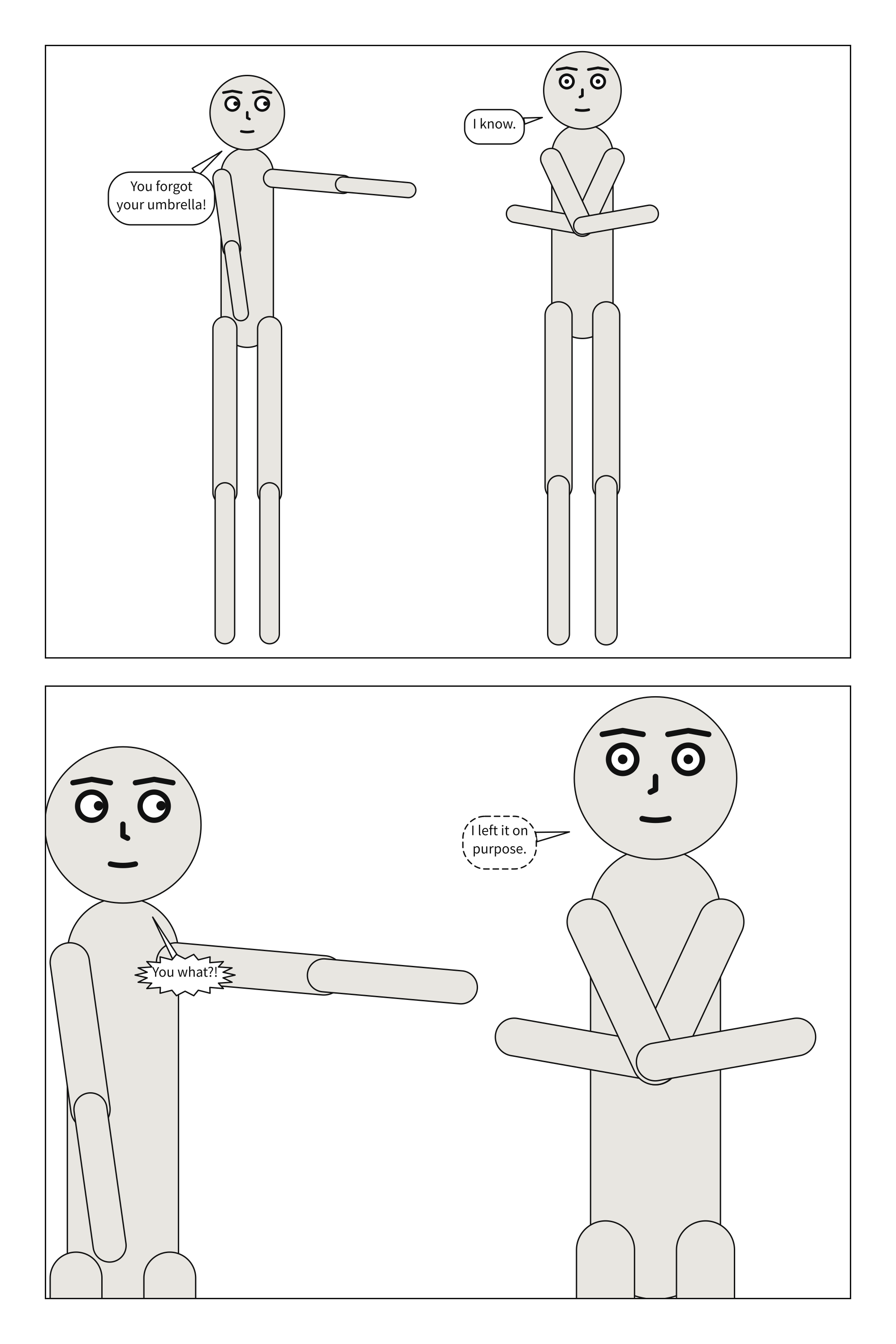
One page, two panels: Alice and Bob on a rainy corner at a full shot, then closer, as Bob whispers that he left his umbrella on purpose and Alice shouts back.
A script#
Save this as a .script file. The part between the two --- lines is the front
matter: YAML, holding what every panel shares, exactly as beside panels: in a scene.
Everything after it is the script.
---
panel:
  size: [900, 640]
cast:
  ALICE: {reference: alice, pose: pointing,     at: left_third}
  BOB:   {reference: bob,   pose: arms_crossed, at: right_third, facing: left}
staging:
  - ALICE left_of BOB
  - ALICE looking_at BOB
  - ALICE ground_shared_with BOB
---

PAGE ONE

PANEL 1
@shot: full_shot
Alice and Bob face each other on a rainy street corner. She is exasperated.

ALICE
You forgot your umbrella!

BOB
I know.

PANEL 2
@shot: medium_close_up
Closer now. Bob will not meet her eye.

BOB (whisper)
I left it on purpose.

ALICE (shouting)
You what?!
scenet build umbrella.script
wrote umbrella.1.svg
wrote umbrella.2.svg
wrote umbrella.page-1.svg
note: 2: camera retreated to 57% of the requested 'medium_close_up' framing so the cast would fit across the panel
The panels are named by their numbers, 1 and 2, and so are their files and notes.
Read it line by line:
Line |
Means |
|---|---|
|
a page: the panels under it are laid out on it |
|
a panel, named by its number |
|
a directive: a key of the panel, here its |
|
prose, for the artist: never interpreted, and kept as the panel’s |
|
a cue, a cast id in capitals alone on its line: the lines under it are what Alice says |
|
a cue with a parenthetical: the balloon’s |
A cue is a name in capitals because the cast’s ids are, ALICE and BOB, in the front
matter. That is how Scenet tells a speech from prose without guessing.
Directives#
A line starting with @ sets a key of the panel it is in. @shot and @angle set the
camera, as camera: {shot: ...} and camera: {angle: ...} would. Any other directive sets
the top-level key it names, in YAML: @setting: {place: shore, time: dusk}, @lettering: {size: 30}, @palette: tinted. A few belong to the script itself:
Directive |
Does |
|---|---|
|
right after a PAGE heading: how many panels each tier holds, from the top |
|
this panel inherits panel 1, as |
|
change the cast for this panel only: here, take Bob out |
Each key card in the language reference gives its
directive in its “Where” row. The cue forms, captions and sounds are under the rules of
Write a comic script: CAPTION: Midnight.
for a caption, SFX: KRAK for a sound, ALICE (OP) for a voice from off panel, BOB (small) for a muttered line.
A script as publishers ask for it#
Dark Horse’s script format numbers each lettered item, puts the panel’s description on the heading’s line, and the page’s panel count in its heading:
---
panel:
  size: [900, 640]
cast:
  MAYA: {reference: alice, pose: pointing,     at: left_third}
  THEO: {reference: bob,   pose: arms_crossed, at: right_third, facing: left}
staging:
  - MAYA left_of THEO
  - MAYA looking_at THEO
  - MAYA ground_shared_with THEO
---
Margo Wren
14 Harbour Lane, Port Ellis

The Lighthouse, Issue 1

PAGE ONE (three panels)

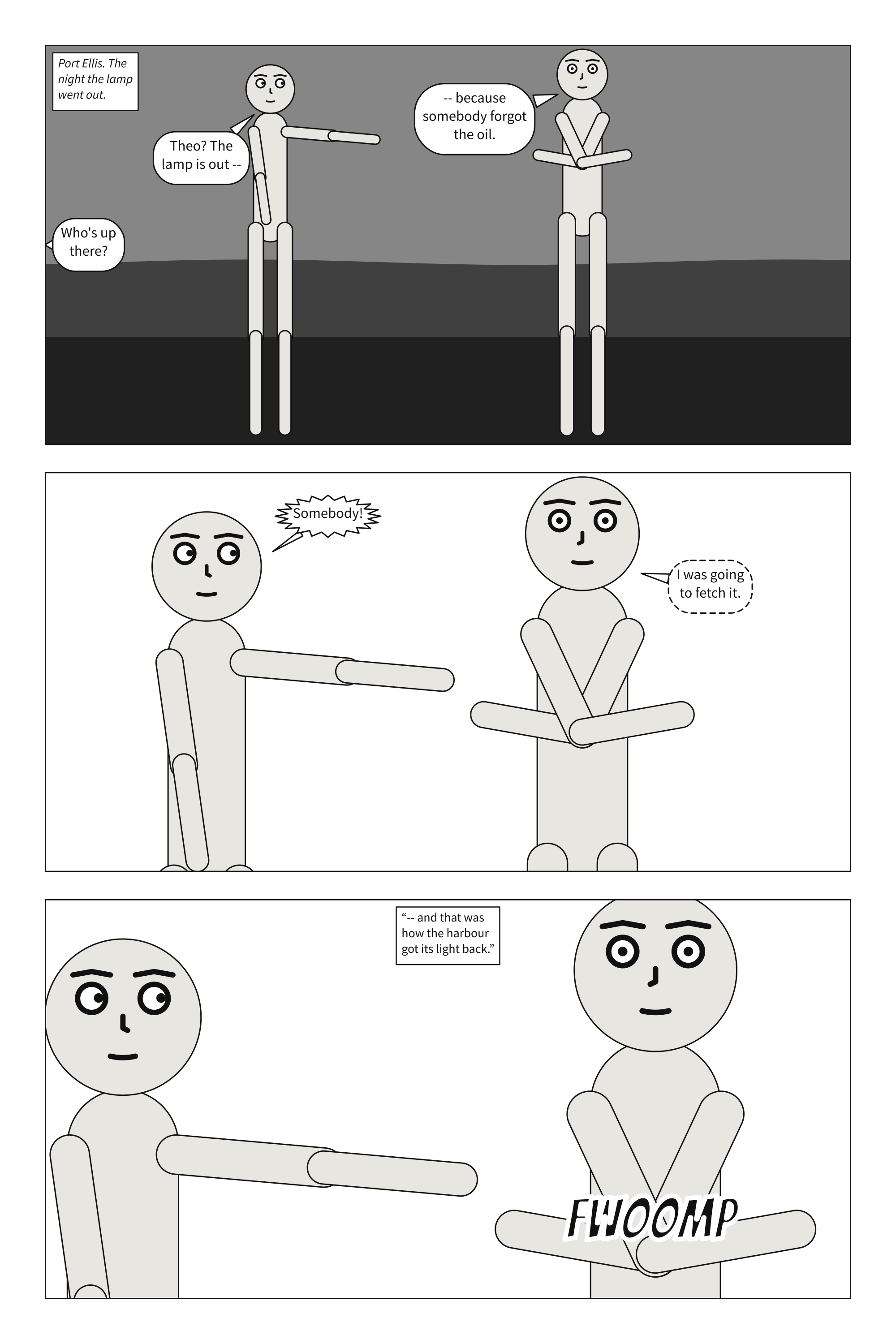
Panel 1. Dusk on the cliff path. Maya has climbed the last of the steps; Theo waits by the door.
@shot: full_shot
@setting: {place: shore, time: dusk}

CAP:
Port Ellis. The night the lamp went out.

MAYA:
Theo? The lamp is out --

THEO:
-- because somebody forgot the oil.

KEEPER (OP):
Who's up there?

Panel 2. Closer. Maya points back down the path, furious.
@shot: medium_shot

1. MAYA (burst):
Somebody!

2. THEO (whisper): I was going to fetch it.

Panel 3. Inside, the lamp blazes again. Both of them squint into the light.
@shot: medium_close_up

SFX (THEO, large): FWOOMP

CAP/MAYA
“-- and that was how the harbour got its light back.”
The writer’s name and the title, before the first PAGE heading, are the title page: kept,
never interpreted. KEEPER (OP) speaks from off panel, and CAP: is a caption whose text
is on the line under it.
What the compiler decided#
A script compiles to a scene. The front matter is what is beside panels:; each panel
heading is a panel, named by its number; each page heading is a page. From there, it is the
compiler of the last two chapters, word for word: the same layout, the same lettering.
Prose is never interpreted. “She is exasperated” draws nothing. Alice is exasperated
only if you give her an expression, with @cast: {ALICE: {expression: angry}}. The prose
becomes the panel’s description, which a screen reader says.
A cue must be somebody in the cast. A name in capitals that the panel does not cast, and
that has no (OP), is set like dialogue but is not read as dialogue:
looks-like-dialogue says so, as a note,
and the line is kept as prose.
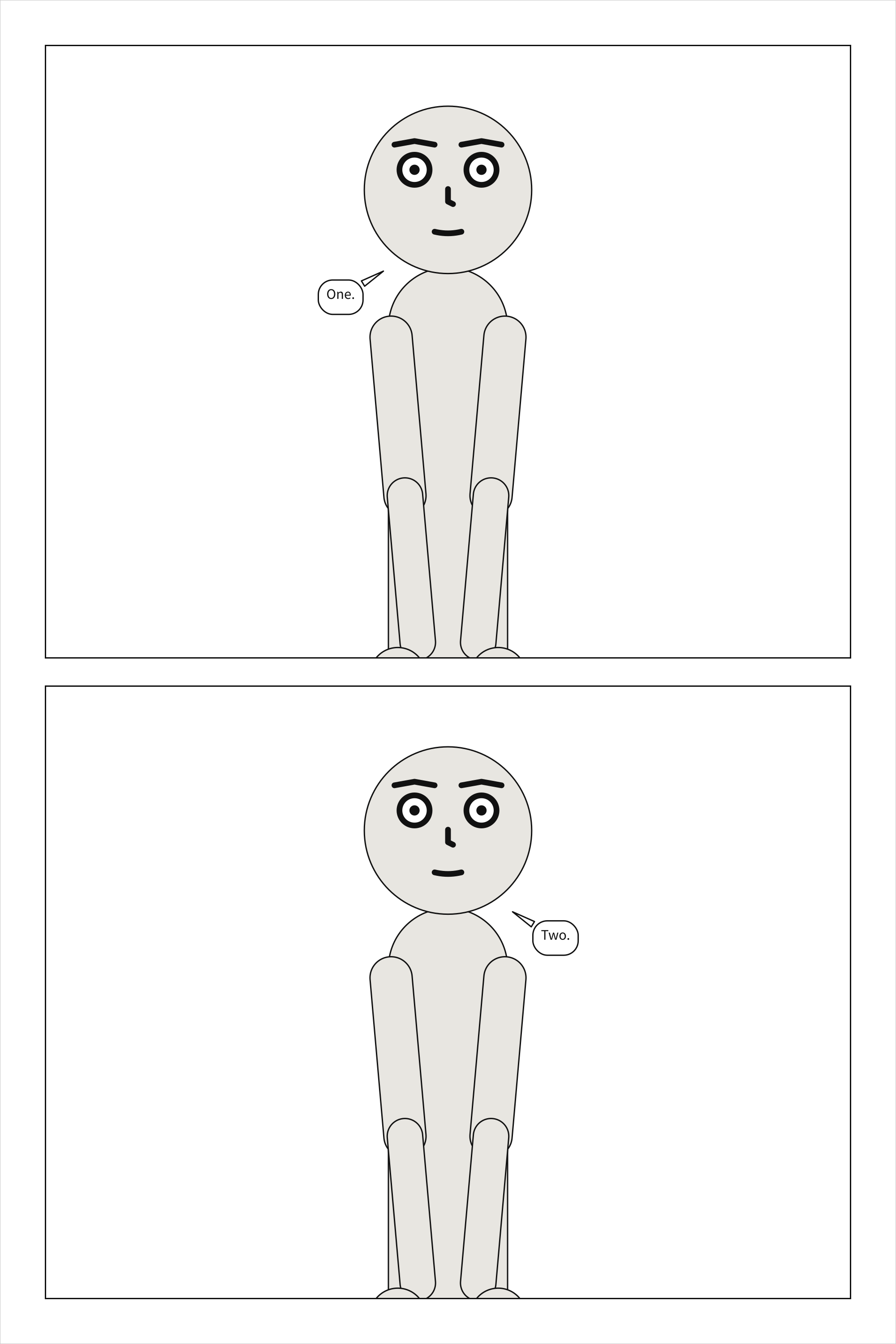
A page’s count is checked. PAGE ONE (three panels) over two panels is a
panel-count note:
---
cast:
  ALICE: {reference: alice}
---
PAGE ONE (three panels)

PANEL 1
ALICE
One.

PANEL 2
ALICE
Two.
Try it#
A comic script: the script you wrote. Add
@angle: lowunderPANEL 2.Dark Horse format: change a cue’s
(burst)to(whisper).Une planche: the same story as a French planche, with
CASEpanels and French shot names.A script in Markdown: headings with
#, labels in bold, as a notes app keeps a script.A manga script: read right to left, the subject of chapter 11.
French shots, abbreviated: PE, PM, PA, and the rest of a French découpage.
French shots in full:
VIGNETTEpanels,CARTOUCHEcaptions.Written like a screenplay: sluglines,
(V.O.)and(O.S.).A letterer’s script: every item numbered in reading order, captions saying what they do.
Check it#
scenet check umbrella.script lighthouse.script
umbrella.script: ok
lighthouse.script: ok
A finding in a script points at the line of the script that caused it, a cue or a directive, not at a line of YAML you never wrote.
What you learned#
A comic script is front matter, in YAML, then pages, panels, prose and cues.
A cue is a cast id in capitals; a parenthetical gives the balloon’s kind,
(small)or(OP).@directives set any key of a panel;@tiers,@overand@castbelong to the script.Prose is the panel’s description, never interpreted.
Dark Horse, Markdown, French, manga, screenplay and letterer’s scripts are all read.
Where to go next#
The next chapter, Your own art and characters.
Write a comic script, every form a script may take.
The
scriptpage, whose cards give each line’s script form.