Bring your own#
Scenet ships two characters and one font, and reads nothing it was not given. This chapter gives it more: a character of your own, a font of your own, the files a document names, handed over from memory, and a picture behind the cast.
What you will build#
A program that compiles documents against assets it chose: a puppet library with a third character, every panel measured in a font of its own, a document’s files supplied as bytes rather than read from a folder, and a panel drawn over a picture, with the picture written into the SVG.
The examples use the files in the gallery’s folders. Save
puppets/pip.puppet.yaml,
fonts/ComicNeue-Regular.ttf
and art/street.png in
folders of those names, beside your scripts.
A puppet library#
A cast member’s reference names a puppet in a
PuppetLibrary.
default_library is the two Scenet ships;
load_puppet reads a puppet file as a
PuppetSpec, which says what the character is
made of and the poses and expressions it can take. A library built by hand holds any puppet
under any name, and library= gives it to a compile:
from pathlib import Path

from scenet import PuppetLibrary, compile_source, default_library, load_puppet

pip = load_puppet(Path("puppets/pip.puppet.yaml"))
print(pip.name, list(pip.poses), list(pip.expressions))

shipped = default_library()
library = PuppetLibrary({"alice": shipped.get("alice"), "pip": pip})
print(library.names())

result = compile_source(
    "cast:\n"
    "  alice: {reference: alice, at: left_third}\n"
    "  pip: {reference: pip, at: right_third, facing: left, pose: waving}\n"
    "staging: [alice left_of pip, alice ground_shared_with pip]\n",
    library=library,
)
print([(actor.id, actor.reference, actor.pose) for actor in result.core.actors])
pip ['standing_neutral', 'waving', 'arms_up'] ['neutral', 'happy', 'surprise', 'scared', 'sad']
('alice', 'pip')
[('alice', 'alice', 'standing_neutral'), ('pip', 'pip', 'waving')]
PuppetLibrary.from_directory(Path("puppets")) reads every puppet file in a folder.
default_library() reads the shipped puppets on each call, so call it once and pass the
library on. Add your own character says how a
puppet file is written.
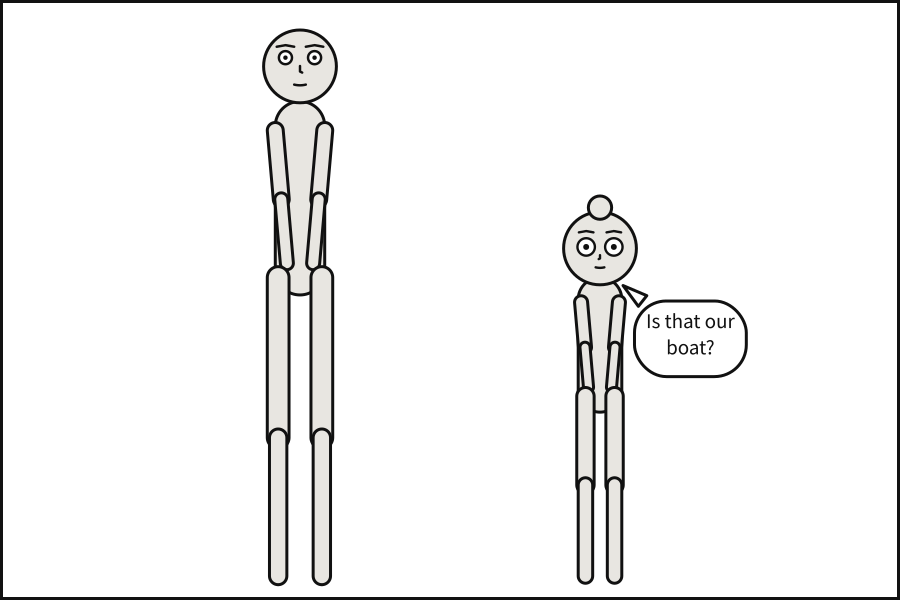
A document can instead name a puppet file by its path, reference: puppets/pip.puppet.yaml,
relative to the document, and needs no library at all. Save this as docks.panel.yaml:
panel: {size: [900, 600]}
camera: {shot: full_shot}
cast:
  alice: {reference: alice, at: left_third}
  pip: {reference: puppets/pip.puppet.yaml, at: right_third, facing: left}
staging:
  - alice left_of pip
  - alice ground_shared_with pip
script:
  - say: {by: pip, text: "Is that our boat?"}
from pathlib import Path

from scenet import compile_file

core = compile_file(Path("docks.panel.yaml")).core
print([actor.reference for actor in core.actors])
print(core.balloons[0].speaker, core.balloons[0].lines)
['alice', 'puppets/pip.puppet.yaml']
pip ('Is that our', 'boat?')
A font of your own: metrics=#
A balloon is the size its text needs, and that is measured in the font it will be drawn
in. A FontMetrics is a font file, read and
measured; Scenet never looks a font up on the system, because what is measured has to be
what is drawn, everywhere. Pass it as metrics= to the compile and the same one to the
renderer, and every panel is lettered in it without a document naming it:
from pathlib import Path

from scenet import FontMetrics, compile_source, render

neue = FontMetrics(Path("fonts/ComicNeue-Regular.ttf"))
text = "cast: {a: {reference: alice}}\nscript: [{say: {by: a, text: In my own face.}}]"

default = compile_source(text).core.balloons[0]
own = compile_source(text, metrics=neue).core.balloons[0]
print(default.box.width, "->", own.box.width)

svg = render(compile_source(text, metrics=neue).core, metrics=neue)
print(svg.startswith("<?xml"))
print(round(neue.measure("In my own face.", 32.0), 2))
189.31 -> 198.06
True
217.79
A document can name a font itself, lettering: {font: fonts/neue.ttf}, as the
first chapter did:
its result’s fonts hand it to the renderer. Letter in your own
font has both, and the faces for italic and bold.
The files a document reads: base=#
A document names its files by paths relative to its own folder: a font, a picture, a
puppet. Compiled from text, it has no folder, and base= gives it one: a Path to read
them from, or a mapping of each path the document writes to the file’s bytes. With a
mapping, nothing is read from disk, which is how to compile a document you did not write:
a path in it may climb out of a folder with ../, and a mapping holds only what you put
in it.
from pathlib import Path

from scenet import compile_source, render

text = (
    "lettering: {font: fonts/neue.ttf}\n"
    "cast: {a: {reference: alice}}\n"
    "script: [{say: {by: a, text: From memory.}}]\n"
)
files = {"fonts/neue.ttf": Path("fonts/ComicNeue-Regular.ttf").read_bytes()}

result = compile_source(text, base=files)
print(len(result.fonts), "font, read from", len(files), "file handed over")
print(render(result.core, fonts=result.fonts).startswith("<?xml"))

from_folder = compile_source(text.replace("neue.ttf", "ComicNeue-Regular.ttf"), base=Path("."))
print(from_folder.core.balloons[0].box == result.core.balloons[0].box)
1 font, read from 1 file handed over
True
True
A file a document names that is not there is the document’s fault, so it is a
PanelSyntaxError that says where the document named it, not a FileNotFoundError.
The Guarantees page says exactly what a compile reads.
A picture behind the cast#
setting: {image: ...} names a PNG or JPEG to draw behind the cast. The compiler reads its
size, and nothing else of it. The Core names the picture by the digest of its bytes, and
the result’s images holds the bytes under that digest, for a renderer to embed:
from pathlib import Path

from scenet import compile_source, render

text = (
    "panel: {size: [900, 500]}\n"
    "setting: {image: art/street.png, fit: cover, time: dusk}\n"
    "cast: {a: {reference: alice}}\n"
)
result = compile_source(text, base={"art/street.png": Path("art/street.png").read_bytes()})
print([digest[:12] for digest in result.images])

svg = render(result.core, embed=result.images)
Path("street.svg").write_text(svg, encoding="utf-8")
print("data:image/png;base64," in svg, 'href="art/street.png"' in render(result.core))
['ed788ebc79d0']
True True
Without embed=, the SVG links the picture by its path, art/street.png, which a viewer
finds beside the SVG; with it, the SVG carries the picture and stands alone. A book’s
images go to render_pdf as images=, and print always carries them. People your
picture already draws can be lettered as figures, with an artwork contract: see
Letter the figures in your art.
What you learned#
Characters are a library:
default_library,load_puppetandPuppetLibrary, passed aslibrary=; or a puppet file a document names by its path.A font is a file, measured as a
FontMetricsand passed asmetrics=to the compile and the renderer, so what is measured is what is drawn.base=is the document’s folder: aPath, or a mapping of paths to bytes, which reads nothing from disk and is the way to compile a document you do not trust.A picture’s bytes travel with the result, as
images, forembed=.
Where to go next#
Outputs, batch and CI: many documents, golden files, and Scenet in CI and in a tool of your own.
Your own art and characters, the author’s chapter on the same files.
The puppet format, and the reference pages of
PuppetLibraryandFontMetrics.