Artwork contracts#
A supplied picture can draw its own people. Where each face, mouth and body is, the panel never
says – it never writes a coordinate. The picture’s artwork contract does: a file beside the
picture, named after it, art/p01-street.art.yaml beside art/p01-street.png, measured once in
the picture’s own pixels and committed with it. A cast member names a figure it declares with
figure:. What the solver does with it is in the
asset contract; this page has a card for every key.
The contract is read only for a panel whose cast names a figure, and its geometry goes through the
picture’s fit, so a face is excluded exactly where the picture draws it,
under cover and contain alike. scenet check reads it without running the solver, and reports a
missing or malformed one as artwork-contract: in the contract itself, at the line of the fault,
when the document is checked as a file; at the line naming the picture when it is checked as text,
as in the playground or over MCP. scenet build --debug draws every face, mouth, body and keep-out
over the panel, which is how a contract is checked against its picture.
An artwork contract#
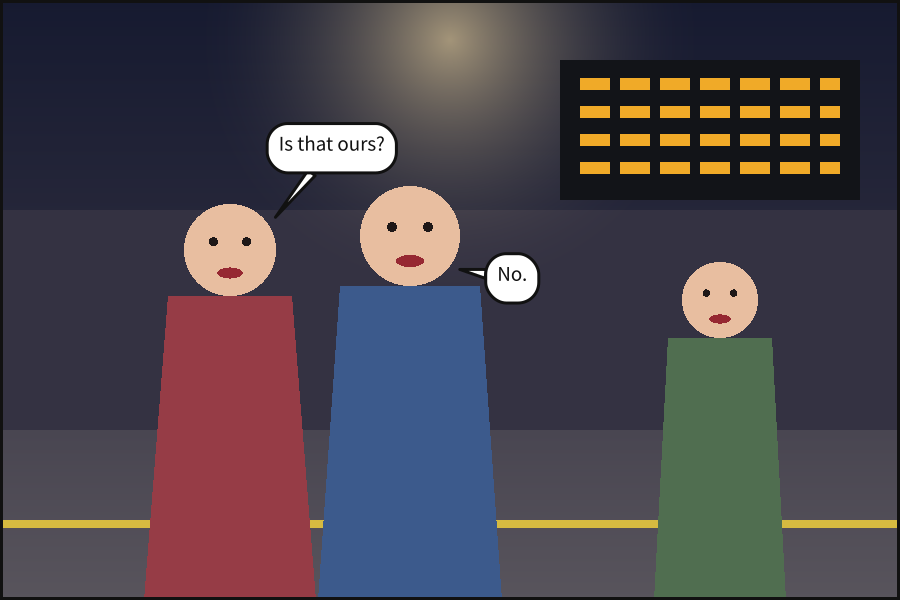
Every card below points here: the gallery’s contract for art/figures.png, a station platform at
night with three people on it, and a panel that casts two of them.
# The artwork contract for figures.png, written by scripts/make_gallery_figures.py
# from the same constants the picture is painted from. Pixels, from the top left.
size: [900, 600]
figures:
  ana:
    face: {center: [230, 250], radius: 56}
    mouth: [230, 273]
    body: [[168, 296], [292, 296], [316, 600], [144, 600]]
  ben:
    face: {center: [410, 236], radius: 60}
    mouth: [410, 261]
    body: [[340, 286], [480, 286], [502, 600], [318, 600]]
  carl:
    face: {center: [720, 300], radius: 46}
    mouth: [720, 319]
    body: [[668, 338], [772, 338], [786, 600], [654, 600]]
keep_out:
  # The timetable board.
  - [[560, 60], [860, 60], [860, 200], [560, 200]]
panel: {size: [900, 600]}
setting: {image: art/figures.png, time: night}
cast:
  ana: {figure: ana}
  ben: {figure: ben}
script:
  - say: {by: ana, text: "Is that ours?"}
  - say: {by: ben, text: "No."}
size#
The picture’s size in pixels, [width, height], as it was measured. It must be the picture’s own.
Where |
An artwork contract, the |
Type |
|
Default |
none: required |
Since |
0.12 |
Diagnostics |
The picture’s size in pixels, as the contract was measured against it. It must be the picture’s own: a contract measured on another size of the picture would put every face somewhere else, so a mismatch is refused rather than scaled. See the example.
figures#
Each figure the picture draws, by the name a cast member’s figure gives it. Every face here is kept clear of lettering, cast or not.
Where |
An artwork contract, the |
Type |
a mapping |
Default |
none |
Since |
0.12 |
Diagnostics |
Everybody the contract declares is in the picture. A face nobody cast is as forbidden to
lettering as a speaker’s, and a body as costly to cover: a crowd of five can be declared and two of
them cast. A figure a panel casts and the contract does not declare is unknown-figure, listing
the ones it does. See the example.
figures.<name>.face#
The figure’s face: a disc no balloon, caption or sound effect may cover.
Where |
An artwork contract, the |
Type |
a mapping |
Default |
none: required |
Since |
0.12 |
Diagnostics |
The face, as a disc. A contract declares no gaze, so nothing keeps a balloon out of a figure’s line of sight; the face is all lettering keeps clear of. See the example.
figures.<name>.face.center#
The face’s centre, [x, y] in the picture’s pixels, from its top left.
Where |
An artwork contract, the |
Type |
|
Default |
none: required |
Since |
0.12 |
Diagnostics |
The face’s centre, in pixels from the picture’s top left; it must lie on the picture. See the example.
figures.<name>.face.radius#
How far the face reaches, in pixels. Generous is safer than tight: no lettering overlaps this disc, and a tail stops on its edge.
Where |
An artwork contract, the |
Type |
a number |
Values |
above 0 |
Default |
none: required |
Since |
0.12 |
Diagnostics |
Generous is safer than tight: no balloon may overlap the disc at all, and a tail stops on its edge.
A cover crop that pushes part of a face out of the panel keeps clear whatever part is in view. See
the example.
figures.<name>.mouth#
Where the tail of a line the figure speaks ends, or the place a sound it makes comes from, in pixels. Left out, a tail aims at the face’s centre.
Where |
An artwork contract, the |
Type |
|
Default |
none |
Since |
0.12 |
Diagnostics |
Where a tail ends, and where a sound the figure makes comes from. A tail to a mouth that a cover
crop cuts away ends on the frame, aimed at it, and scenet build says so in a note. See
the example.
figures.<name>.body#
The figure’s silhouette, a polygon in pixels, which a balloon pays to cover: half as much over its own speaker.
Where |
An artwork contract, the |
Type |
a list of |
Default |
none |
Since |
0.12 |
Diagnostics |
A polygon of at least three points, in pixels, simple – no edge crossing another. Covering a figure’s body costs a balloon, and covering its own speaker’s costs half, as with a puppet. See the example.
keep_out#
Regions lettering should stay off, each a polygon in pixels: a sign, a hand, what the panel is about. A cost, not a rule.
Where |
An artwork contract, the |
Type |
a list of a list of |
Default |
none |
Since |
0.12 |
Diagnostics |
Keep-out regions are ground lettering pays to cover, weighted as emanata are – a sign, a hand, what the panel is about – and never forbidden: a crowded panel covers one before it fails. Each is a simple polygon on the picture. See the example.