Your own art and characters#
Everything so far was drawn by Scenet: its puppets, its places. This chapter brings in work of your own. A picture you painted, behind the cast; people your picture already draws, lettered over; and a character of your own, as a puppet file.
What you will make#
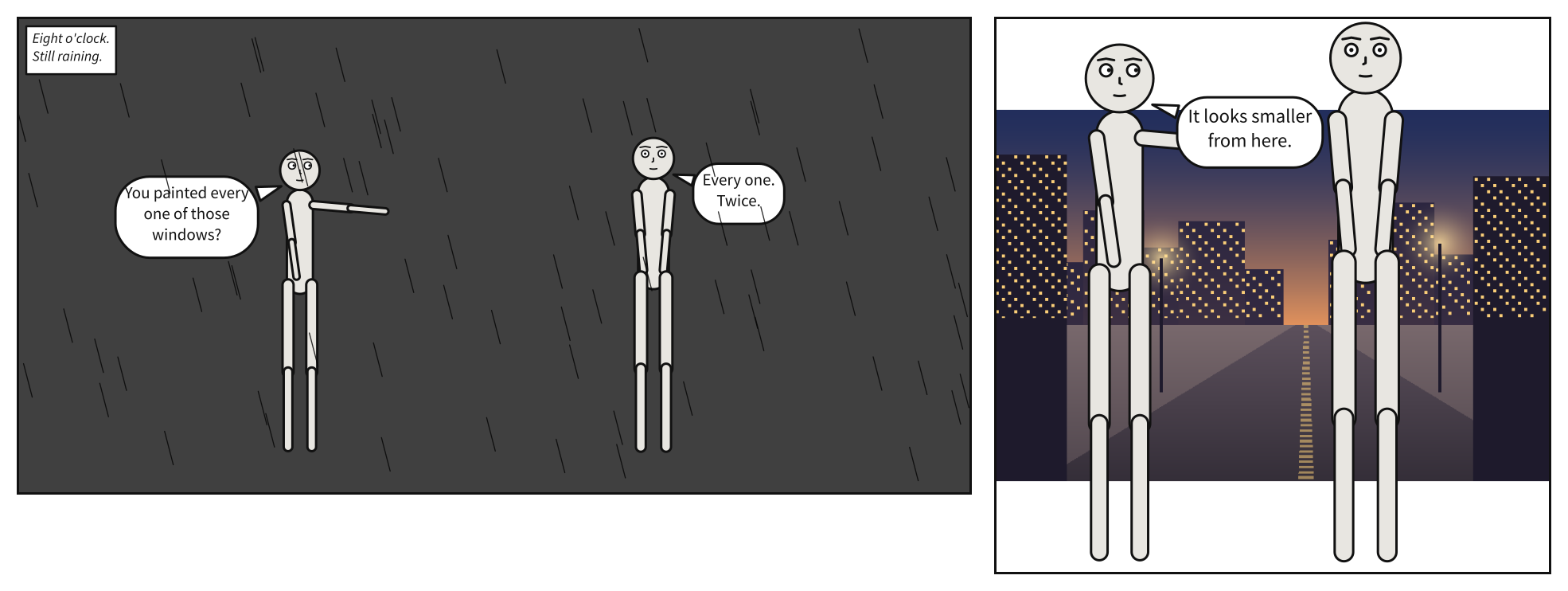
A street at dusk, painted elsewhere, with Alice and Bob in front of it in the rain; then the same picture framed whole, in a square panel, on a clear evening.
A picture behind the cast#
setting.image names a PNG or JPEG file,
relative to the document, and draws it behind the cast in place of a place.
fit says how it fills the panel, keeping its
proportions: cover fills it and crops what overhangs; contain shows the whole picture,
with the panel showing round it.
The picture here is art/street.png, in
examples/gallery/art/.
Save it in a folder art/ beside the document, or use a picture of your own.
# A picture drawn elsewhere, behind the cast.
#
# `image` names a PNG or JPEG beside this document -- art/street.png, painted by
# scripts/make_gallery_art.py -- and the cast is drawn in front of it and lettered by the
# same rules as on any other backdrop. The compiler reads the picture's size and nothing
# else: it does not know there is a road, so a balloon pays nothing to sit on it.
#
# `fit` says how the picture fills the panel, keeping its proportions: `cover` fills it
# and crops what overhangs, equally top and bottom here; `contain` shows the whole
# picture, and the panel shows round it. Weather is drawn over the picture as over masses.
#
# A link by default -- the SVG names art/street.png, as written -- or the picture's own
# bytes with `scenet build --embed-images`, which the playground always uses.

camera:
  shot: long_shot

cast:
  alice: {reference: alice, at: left_third, pose: pointing}
  bob:   {reference: bob,   at: right_third, facing: left}

staging:
  - alice left_of bob
  - alice looking_at bob
  - alice ground_shared_with bob

setting: {image: art/street.png, time: dusk}

panels:
  arrival:
    panel: {size: [1200, 600]}
    setting: {fit: cover, weather: rain}
    script:
      - caption: {text: "Eight o'clock. Still raining.", kind: locale, prefer: top_left}
      - say: {by: alice, text: "You painted every one of those windows?"}
      - say: {by: bob, text: "Every one. Twice."}

  framed:
    over: arrival
    panel: {size: [700, 700]}
    camera: {shot: full_shot}
    setting: {fit: contain, weather: clear}
    script:
      - say: {by: alice, text: "It looks smaller from here."}
scenet build street.scene.yaml --embed-images
wrote street.arrival.svg
wrote street.framed.svg
By default the SVG links the picture by the path you wrote, so it shows only beside it.
--embed-images writes the picture’s bytes into the SVG, which can then go anywhere. A JPEG
works the same way:
# A JPEG behind the cast.
#
# A supplied picture may be a PNG or a JPEG, the two raster formats every SVG viewer must
# draw. The compiler tells them apart by their first bytes, not by the file's name, and
# reads nothing but the size from either. This one, art/harbour.jpg, was painted and
# encoded by scripts/make_gallery_photo.py.
#
# `time: dawn` changes nothing in the picture, whose values are the artist's: over a
# picture, the hour only tints weather, and there is none.

panel:
  size: [1200, 700]

camera:
  shot: full_shot

setting:
  image: art/harbour.jpg
  fit: cover
  time: dawn

cast:
  alice: {reference: alice, at: left_third, pose: pointing}
  bob:   {reference: bob,   at: center, facing: left}

staging:
  - alice left_of bob
  - alice looking_at bob

script:
  - say: {by: alice, text: "The first boat leaves at six."}
  - say: {by: bob, text: "Then we have time for coffee."}
Figures the picture draws#
When the people are in the picture already, nobody needs posing. A cast member names a
figure the picture draws, instead of a puppet,
and the picture’s artwork contract says where each figure’s face, mouth and body are, in
the picture’s pixels. The contract is a YAML file beside the picture, named after it:
figures.png has figures.art.yaml.
# The artwork contract for figures.png, written by scripts/make_gallery_figures.py
# from the same constants the picture is painted from. Pixels, from the top left.
size: [900, 600]
figures:
  ana:
    face: {center: [230, 250], radius: 56}
    mouth: [230, 273]
    body: [[168, 296], [292, 296], [316, 600], [144, 600]]
  ben:
    face: {center: [410, 236], radius: 60}
    mouth: [410, 261]
    body: [[340, 286], [480, 286], [502, 600], [318, 600]]
  carl:
    face: {center: [720, 300], radius: 46}
    mouth: [720, 319]
    body: [[668, 338], [772, 338], [786, 600], [654, 600]]
keep_out:
  # The timetable board.
  - [[560, 60], [860, 60], [860, 200], [560, 200]]
Its size is the picture’s, in pixels. Each of its
figures has a face, a disc no lettering may
cover; a mouth, where a tail ends; and a body, which a balloon pays to cover.
keep_out lists what else the lettering should
stay off: here, a timetable board.
# Figures a picture draws, lettered over.
#
# The people are in the picture -- art/figures.png, painted by
# scripts/make_gallery_figures.py -- so the cast names them with `figure:` instead of
# posing puppets. Where each face, mouth and body is lives in the picture's artwork
# contract, art/figures.art.yaml, beside it and named after it; this document writes no
# coordinate. Balloons keep off every declared face, Carl's too though nobody cast him,
# tails aim at each speaker's mouth, and the timetable board is a keep-out: lettering
# pays to cover it, and does not.
#
# Nobody is posed, placed or framed: the artist did all of that, so there is no camera
# and no staging. `fit` maps the contract through the same transform as the picture.

cast:
  ana: {figure: ana}
  ben: {figure: ben}

setting: {image: art/figures.png, time: night}

panels:
  platform:
    panel: {size: [1200, 600]}
    setting: {fit: cover}
    script:
      - caption: {text: "The last train. Again.", kind: locale}
      - say: {by: ana, text: "Is it always this late?"}
      - say: {by: ben, text: "Only when it rains somewhere else."}

  waiting:
    over: platform
    panel: {size: [600, 700]}
    setting: {fit: contain}
    script:
      - say: {by: ana, text: "Is that ours?"}
      - say: {by: ben, text: "No."}
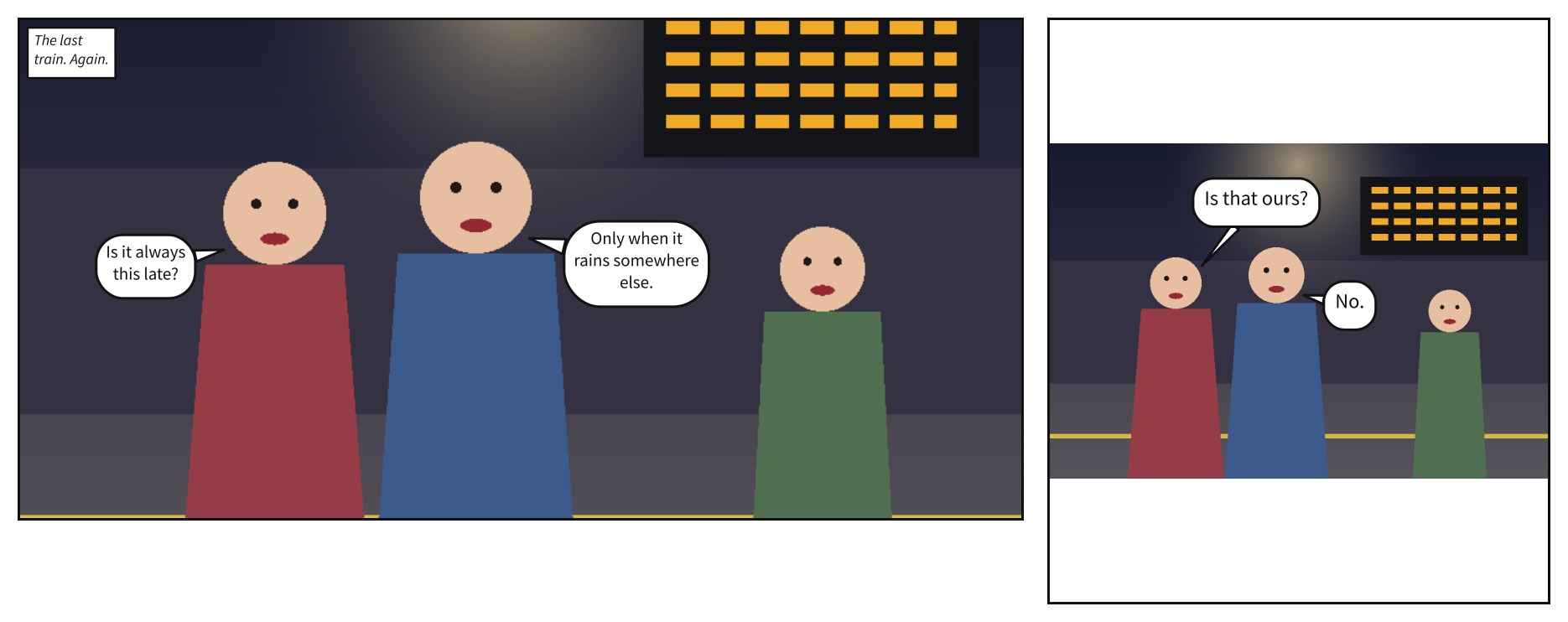
Carl is in the contract and not in the cast: nobody speaks for him, but his face is still kept clear.
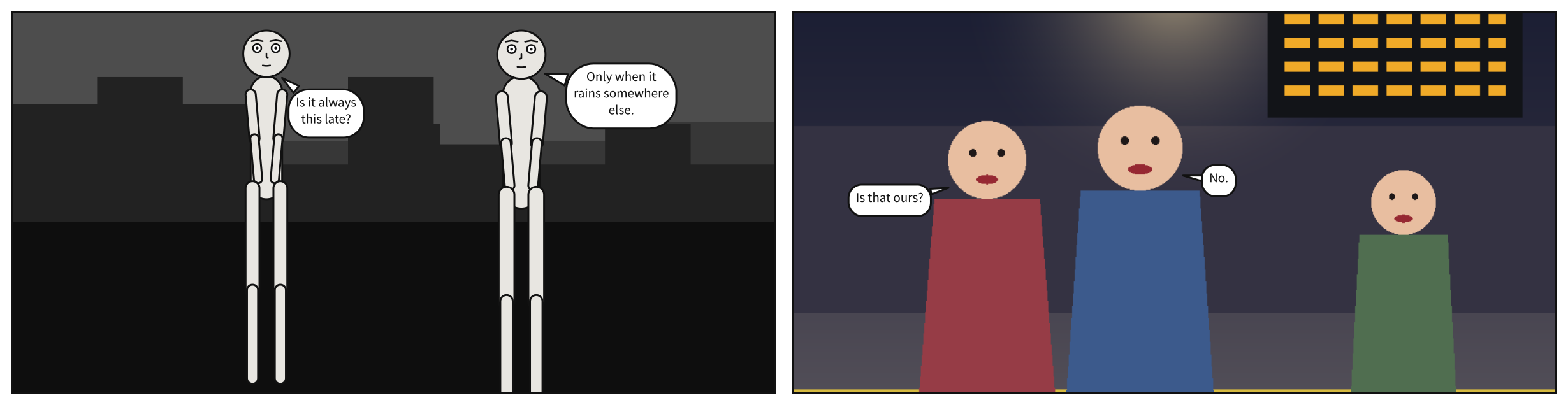
A panel over one of puppets can turn them into figures, taking away with null what only
a puppet has:
# From puppets to figures: the same two people, drawn first by Scenet, then by a picture.
#
# In the first panel Ana and Ben are puppets in a named place. The second is `over:` it, and
# takes everything it does not take away with `null`:
#
# - `place: null` beside its `image`, since a picture is a backdrop of its own;
# - `camera: null`, since the artist already framed the picture;
# - `reference: null` beside each `figure`, and every key that posed the puppet -- `at`,
#   `facing` -- since a member is a puppet or a figure, never both.
#
# The picture's artwork contract, art/figures.art.yaml, says where each face and mouth is.

panels:
  waiting:
    panel: {size: [1200, 600]}
    camera: {shot: full_shot}
    setting: {place: street, time: night}
    cast:
      ana: {reference: alice, at: left_third}
      ben: {reference: bob,   at: right_third, facing: left}
    script:
      - say: {by: ana, text: "Is it always this late?"}
      - say: {by: ben, text: "Only when it rains somewhere else."}

  platform:
    over: waiting
    camera: null
    setting: {place: null, image: art/figures.png, fit: cover}
    cast:
      ana: {reference: null, figure: ana, at: null}
      ben: {reference: null, figure: ben, at: null, facing: null}
    script:
      - say: {by: ana, text: "Is that ours?"}
      - say: {by: ben, text: "No."}
A puppet of your own#
Scenet ships two puppets, alice and bob. A character of your own is a puppet file,
*.puppet.yaml, which a cast names by its path:
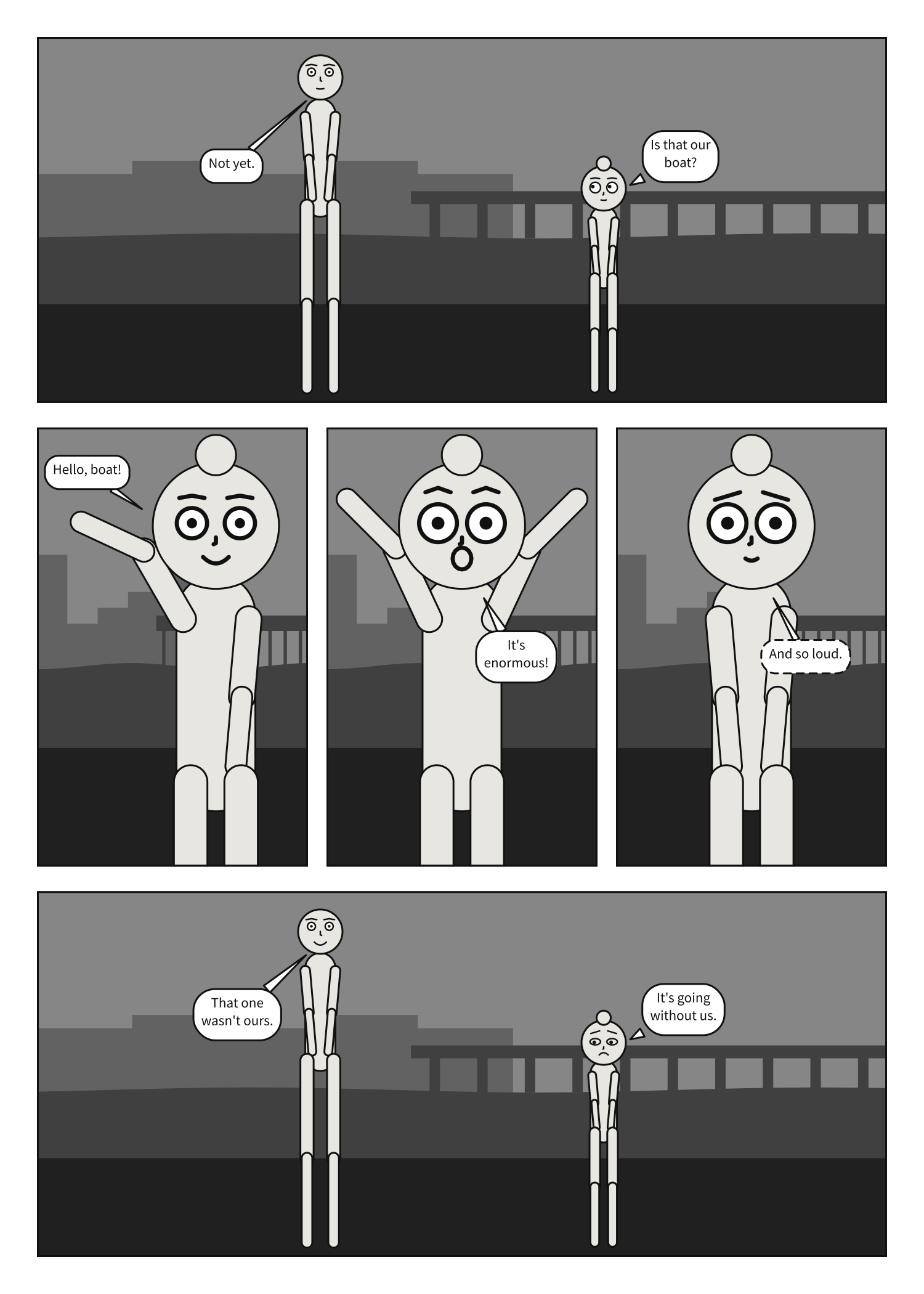
reference: puppets/pip.puppet.yaml. This is pip, a child five heads tall:
# Pip: a child, five heads tall, and the gallery's own puppet -- Scenet does not ship it.
#
# A document casts it by its path, relative to the document, as it names a font or a
# picture: `reference: puppets/pip.puppet.yaml`. The `name:` below is what a message calls it.
#
# What sets it apart from alice and bob, who are both seven and a half heads tall:
#
# - Five heads, not seven and a half. A head is the same 100 units as alice's, so the body
#   below it is shorter, and the head is big for it -- a child's proportion. At the same
#   shot, a camera that framed by fractions of the panel instead of by landmarks in heads
#   would get pip visibly wrong.
# - Big eyes, set low in the face, a small nose and a small mouth.
# - A knot of hair on top of the head: a blob, as the head is, so pip reads as pip even at
#   a distance, where a face is too small to draw.
#
# Values are native units, one head being 100; landmarks are measured down from the top of
# the head, and each joint's offset from its parent's. The root sits at the waist.

name: pip
units_per_head: 100
root: root
root_landmark: waist

landmarks:
  head_top: 0
  eyes: 50
  chin: 100
  shoulders: 120
  chest: 165
  waist: 245
  mid_thigh: 320
  knees: 375
  feet: 500

joints:
  root: {parent: null, offset: [0, 0]}
  spine: {parent: root, offset: [0, -80]}
  neck: {parent: spine, offset: [0, -45]}
  head: {parent: neck, offset: [0, -70]}

  shoulder_l: {parent: neck, offset: [-26, 4]}
  shoulder_r: {parent: neck, offset: [26, 4]}
  elbow_l: {parent: shoulder_l, offset: [0, 62]}
  elbow_r: {parent: shoulder_r, offset: [0, 62]}
  wrist_l: {parent: elbow_l, offset: [0, 55]}
  wrist_r: {parent: elbow_r, offset: [0, 55]}

  hip_l: {parent: root, offset: [-20, 8]}
  hip_r: {parent: root, offset: [20, 8]}
  knee_l: {parent: hip_l, offset: [0, 122]}
  knee_r: {parent: hip_r, offset: [0, 122]}
  ankle_l: {parent: knee_l, offset: [0, 125]}
  ankle_r: {parent: knee_r, offset: [0, 125]}

parts:
  - {from: neck, to: root, width: 64}
  - {from: shoulder_l, to: elbow_l, width: 22}
  - {from: elbow_l, to: wrist_l, width: 18}
  - {from: shoulder_r, to: elbow_r, width: 22}
  - {from: elbow_r, to: wrist_r, width: 18}
  - {from: hip_l, to: knee_l, width: 28}
  - {from: knee_l, to: ankle_l, width: 24}
  - {from: hip_r, to: knee_r, width: 28}
  - {from: knee_r, to: ankle_r, width: 24}
  - {at: head, radius: 50}
  - {at: head, radius: 16, offset: [0, -56]}   # the knot of hair

anchors:
  head_top: {joint: head, offset: [0, -50]}
  eyes: {joint: head, offset: [0, 0]}
  mouth: {joint: head, offset: [0, 26]}
  feet: {joint: root, offset: [0, 255]}

face:
  joint: head
  radius: 60
  # Feature points ride the head joint, so they mirror and scale with it. `size` means an
  # eye's radius, a brow's or mouth's half-width, a nose's length.
  features:
    brow_l: {offset: [-19, -22], size: 10}
    brow_r: {offset: [19, -22], size: 10}
    eye_l:  {offset: [-19, -2], size: 12}
    eye_r:  {offset: [19, -2], size: 12}
    nose:   {offset: [0, 12], size: 6}
    mouth:  {offset: [0, 26], size: 12}

gaze:
  origin: eyes

poses:
  standing_neutral:
    elbow_l: -5
    elbow_r: 5

  waving:
    elbow_l: -5
    elbow_r: -150
    wrist_r: 35

  arms_up:
    elbow_l: 155
    wrist_l: -20
    elbow_r: -155
    wrist_r: 20

expressions:
  neutral:  {}
  happy:    {mouth: smile}
  surprise: {brow: raised,     eyes: wide, mouth: open}
  scared:   {brow: angled_out, eyes: wide, mouth: small}
  sad:      {brow: angled_out, eyes: half, mouth: frown}
A puppet file is the character’s geometric contract, nothing more:
its
name, andunits_per_head, the size of a head in its own units;its
landmarks, the crop lines a shot frames by, measured down from the top of the head;its skeleton: a
rootjoint at aroot_landmark, and thejointsthat hang from it;the
partsits body is drawn from, back to front;its
face, namedanchorssuch as its mouth, and where itsgazestarts;the
posesandexpressionsit can take, by name.
Pip’s are its own: it waves and throws its arms up, where Alice points.
# A puppet of your own: pip, a child five heads tall, at the docks with alice.
#
# Scenet ships two puppets, alice and bob, and pip is not one of them. Its file,
# pip.puppet.yaml, is in puppets/, beside this document, and the cast names it by that path:
# relative to the folder the document is in, as a font or a picture is named. The
# playground writes it there for you, and Puppet... adds one of your own the same way.
#
# A puppet file says what a character is made of -- landmarks, joints, the parts drawn, a
# face -- and the poses and expressions it can take, by name. Pip's are its own: it waves
# and throws its arms up, where alice points and crosses hers. This page draws every pose
# and every expression pip has.
#
# Pip is five heads tall to alice's seven and a half. The camera frames each shot by the
# landmarks a puppet declares, counted in heads, so pip fills a panel of its own at the
# shot asked for. Beside alice, `ground_shared_with` stands them on one ground, and pip
# comes up to her chest; without it, each would be framed alone, head under the top of the
# panel, and pip would float.

page: {size: [1500, 2100], margin: 60, gutter: 30, tier_gutter: 40}
setting: {place: docks, time: dusk}

cast:
  alice: {reference: alice, at: left_third}
  pip: {reference: puppets/pip.puppet.yaml, at: right_third, facing: left}

pages:
  - tiers:
      - panels: [quay]
      - {height: 1.2, panels: [wave, enormous, loud]}
      - panels: [gone]

panels:
  quay:
    camera: {shot: full_shot}
    staging: [alice left_of pip, pip looking_at alice, alice ground_shared_with pip]
    script:
      - say: {by: pip, text: "Is that our boat?"}
      - say: {by: alice, text: "Not yet."}

  wave:
    camera: {shot: cowboy}
    cast:
      alice: null
      pip: {pose: waving, expression: happy, at: center}
    script:
      - say: {by: pip, text: "Hello, boat!"}

  enormous:
    camera: {shot: cowboy}
    cast:
      alice: null
      pip: {pose: arms_up, expression: surprise, at: center}
    script:
      - say: {by: pip, text: "It's enormous!"}

  loud:
    camera: {shot: cowboy}
    cast:
      alice: null
      pip: {expression: scared, at: center}
    script:
      - say: {by: pip, text: "And so loud.", kind: whisper}

  gone:
    camera: {shot: full_shot}
    cast:
      alice: {expression: happy}
      pip: {expression: sad}
    staging: [alice left_of pip, pip looking_at alice, alice ground_shared_with pip]
    script:
      - say: {by: pip, text: "It's going without us."}
      - say: {by: alice, text: "That one wasn't ours."}
scenet build docks.scene.yaml
What the compiler decided#
The picture is read for its size, and nothing else. The compiler does not know there is a road in the street, so a balloon pays nothing to sit on it. What it knows of a picture is what a contract tells it: faces, mouths, bodies and what to keep out of.
A figure is already framed. The artist posed, placed and framed the people, so a cast of
figures has no camera and no staging. A camera beside figures is
figure-staging; a cast member that is a
puppet and a figure at once is
conflicting-cast.
Pip is framed in heads, like anyone. A shot is a crop landmark in head heights, so the
camera frames pip by the landmarks its file declares. Beside Alice, ground_shared_with
stands them on one ground, and pip comes up to her chest.
A file the document names must be there and be right. A missing picture is
image-file, a contract that does not fit its
picture artwork-contract, a figure the
contract lacks unknown-figure, and a puppet
file with a mistake in it puppet-file:
cast:
  carol: {reference: carol}
A reference that is no shipped puppet and no file is
unknown-puppet.
Try it#
Supplied art: the scene you built. Swap
coverandcontain.Figures in a picture: give Carl a line,
{figure: carl}in the cast.Puppets to figures: delete
camera: null, and read the finding.A JPEG: set
fit: contain.A puppet of your own: the Puppet… button adds a puppet file of your own, as pip was.
Check it#
scenet check street.scene.yaml platform.scene.yaml docks.scene.yaml
street.scene.yaml: ok
platform.scene.yaml: ok
docks.scene.yaml: ok
check reads every file a document names: the picture’s size, its contract, the puppet
file, and every pose and expression the cast asks of it.
What you learned#
setting.imagedraws a PNG or JPEG behind the cast;fitiscoverorcontain.figurecasts somebody the picture draws, from its artwork contract: faces, mouths, bodies, and what to keep out of.A puppet file is a character of your own: landmarks, a skeleton, parts, a face, and the poses and expressions it can take.
Pictures, contracts and puppets are files beside the document, named by relative paths.
Where to go next#
The next chapter, Right to left.
Letter over your own art, Letter the figures in your art and Add your own character.
The artwork contract and puppet file pages, and the normative asset contract.