Lettering and sound#
The last chapter decided where words go. This one is about the words themselves: where a line breaks, a stressed word, the size of the type, a font of your own, capitals, and the letters that are part of the picture, sound effects.
What you will make#
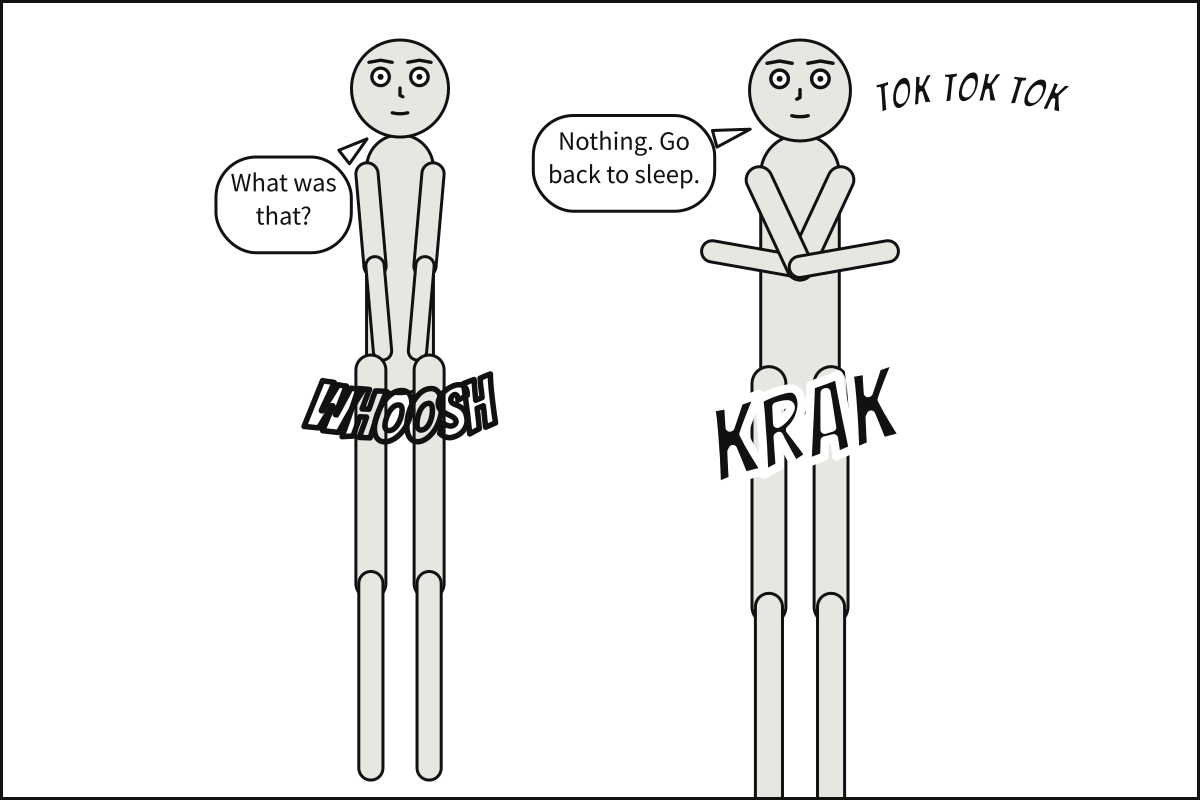
A crack from Bob’s side, a knocking at the top right, a whoosh as Alice turns, each lettered in the display face and none in a balloon. The balloons settle round them.
Where a line breaks#
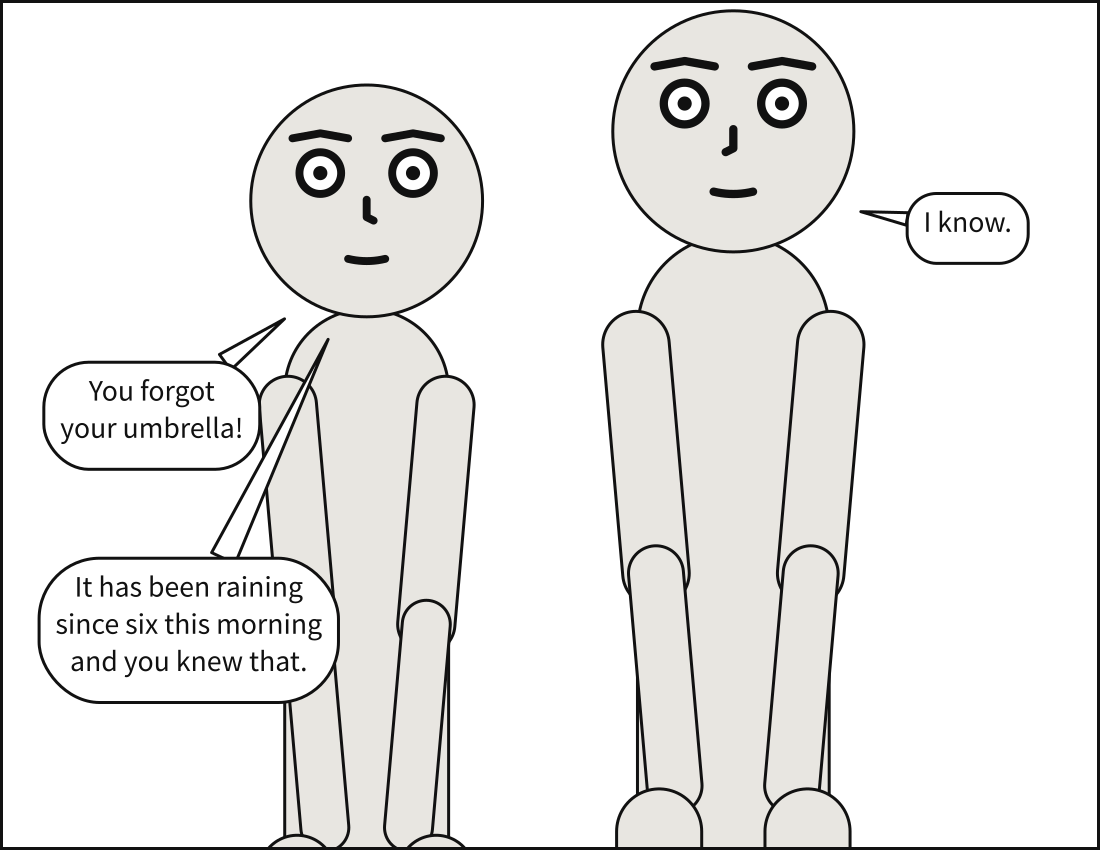
You never break a line yourself. Write each line as one string, and the compiler measures it against the real metrics of the real font, then chooses the breaks a letterer would: a phrase that fits on one line is not split, and no line is left stranded far shorter than its neighbours.
# Never break lines yourself. Where text breaks is decided during compilation,
# measured against the real metrics of the real font, and scored on how close the
# resulting block comes to the shape a letterer would choose.
#
# Two rules the scoring exists to enforce: a phrase that fits on one line is not
# split, even where splitting scores marginally better on aspect ratio; and no line is
# left stranded far shorter than its neighbours.

panel:
  size: [1100, 850]

camera:
  shot: medium_shot

cast:
  alice: {reference: alice, at: left_third}
  bob:   {reference: bob,   at: right_third, facing: left}

staging:
  - alice left_of bob
  - alice ground_shared_with bob

script:
  - say: {by: alice, text: "You forgot your umbrella!", prefer: top_left}
  - say: {by: bob,   text: "I know."}
  - say: {by: alice, text: "It has been raining since six this morning and you knew that."}
A stressed word#
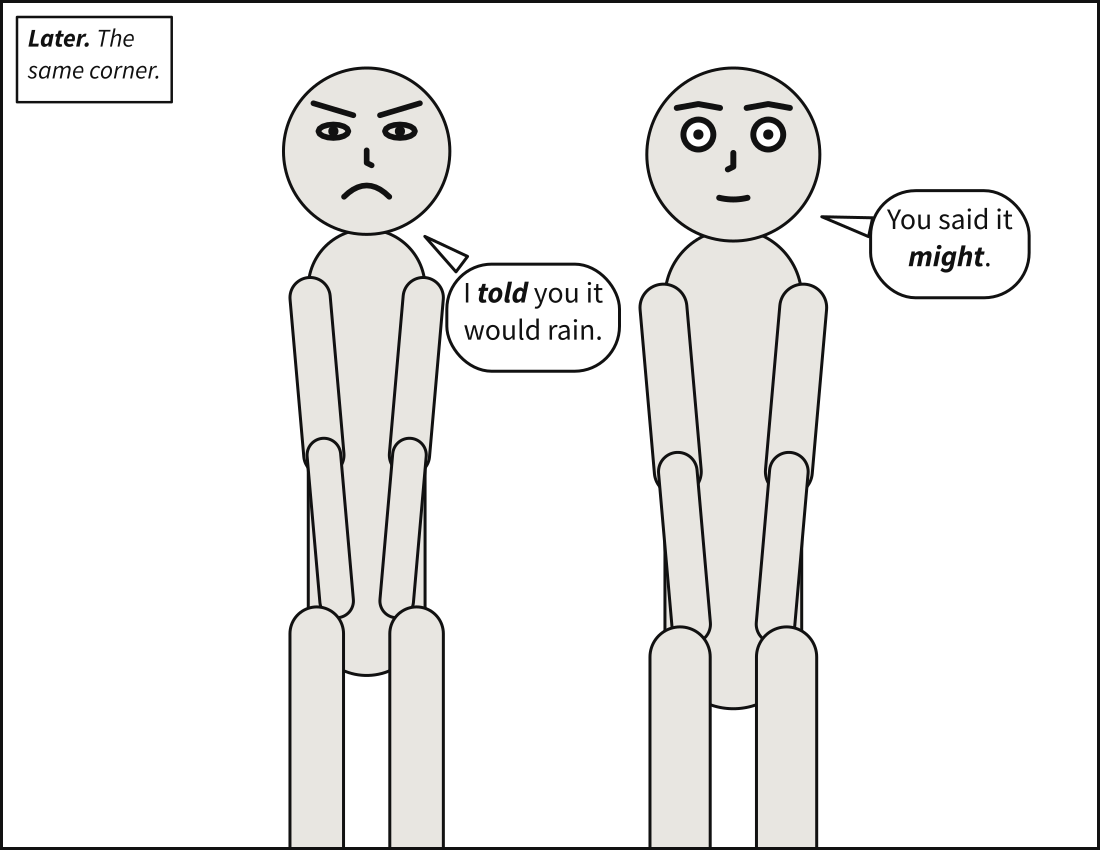
A word between underscores, _word_, is stressed: lettered in bold italic, the letterers’
convention for emphasis, in balloons and captions alike. It is measured in bold italic too,
so a stressed word widens its balloon by exactly as much as it is drawn wider. An
underscore inside a word, as in file_name, is just an underscore.
# A word between underscores is stressed, the way a script underlines it, and lettered
# in bold italic -- the letterers' convention for emphasis, in balloons and captions
# alike.
#
# The stressed word is measured in bold italic as well as drawn in it. Bold italic is
# wider than roman, so a stressed word widens its balloon by exactly as much as it is
# drawn wider. An underscore inside a word, as in file_name, is just an underscore.

panel:
  size: [1100, 850]

camera:
  shot: cowboy

cast:
  alice: {reference: alice, at: left_third, expression: angry}
  bob:   {reference: bob,   at: right_third, facing: left}

staging:
  - alice left_of bob

script:
  - caption: {text: "_Later._ The same corner.", kind: locale}
  - say: {by: alice, text: "I _told_ you it would rain."}
  - say: {by: bob,   text: "You said it _might_."}
The size of the type#
lettering.size is the one lettering
measurement you set: the dialogue type size, in the units of the panel. Captions keep their
proportion to it. Left out, dialogue is lettered at 3.5% of the panel’s height, or, on a page,
of one tier of a three-tier page, so that a short panel and a tall one on the same page are
lettered alike.
# Type size: the one lettering measurement you set.
#
# Left alone, dialogue is lettered at 3.5% of the height a panel letters against -- on a
# page, one tier of a three-tier page. `lettering: {size: N}` chooses instead: the
# dialogue size, in the same units as the page and its panels. Captions keep their
# proportion to it.
#
# Set beside `panels:`, as here, every panel inherits it, so the whole page letters at
# one size: a short tier and a tall one alike. Set on one panel, it letters that panel
# alone.

lettering: {size: 26}

page: {size: [1500, 2250], margin: 75, gutter: 30, tier_gutter: 45}

cast:
  alice: {reference: alice, at: left_third}
  bob:   {reference: bob,   at: right_third, facing: left}

staging:
  - alice left_of bob

pages:
  - tiers:
      - panels: [door]
      - {height: 2, panels: [inside]}

panels:
  door:
    camera: {shot: wide}
    script:
      - caption: {text: "The same evening.", kind: locale}
      - say: {by: alice, text: "Can I come in?"}

  inside:
    camera: {shot: medium_shot}
    script:
      - say: {by: bob, text: "You're letting the rain in."}
      - say: {by: alice, text: "Then let me in faster."}
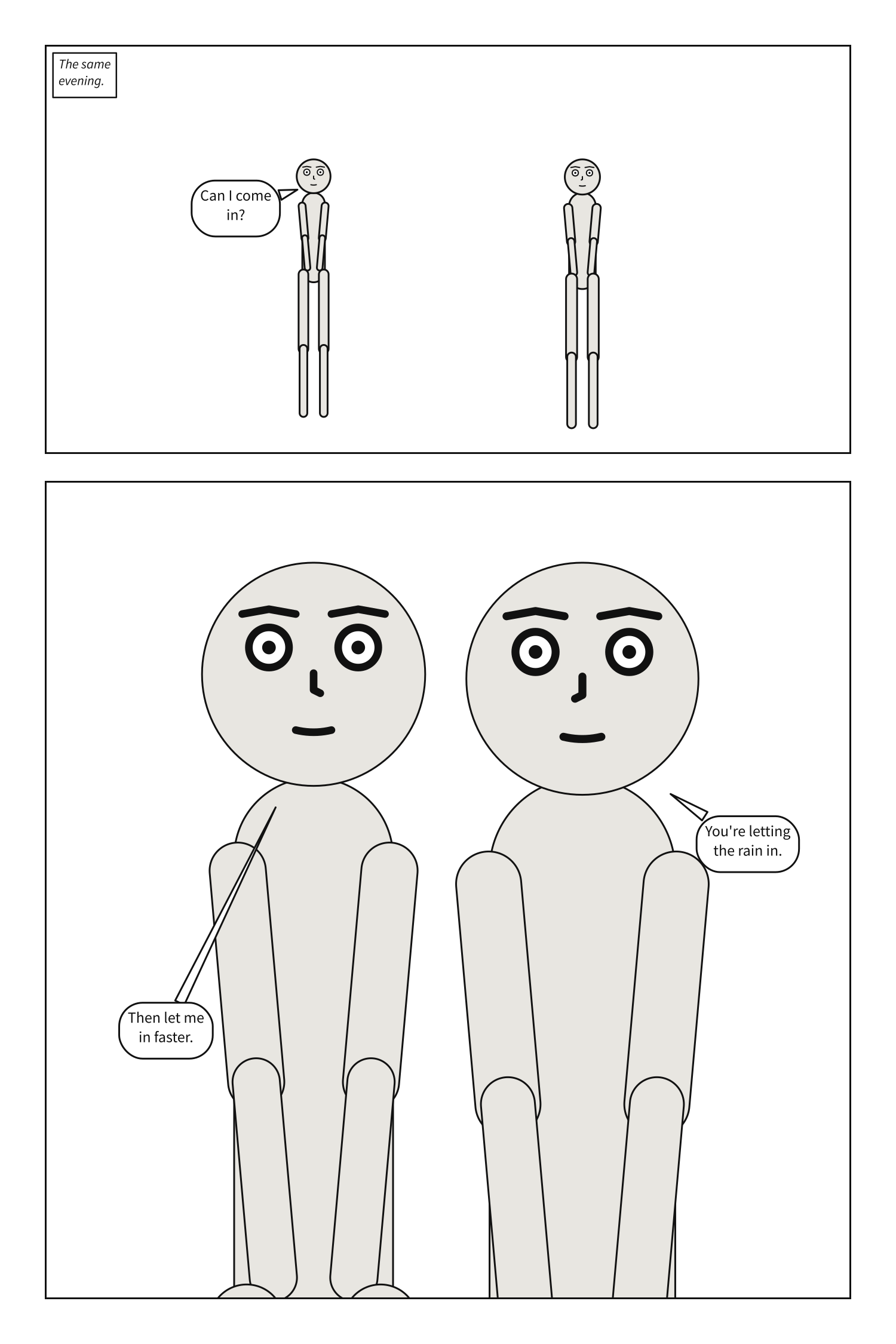
Written beside panels:, as here, every panel inherits the size. Written on one panel, it
letters that panel alone. A single line can still be set smaller with size: small, as in
the last chapter.
A font of your own#
lettering.font names the font files to
letter in, relative to the document. A font is always a file you name, never one installed on
the machine, because what the compiler measures must be the same everywhere. Name one file,
which letters every face, or one per face:
Face |
Letters |
Left out |
|---|---|---|
dialogue and |
the shipped face |
|
every other caption |
the regular face stands in |
|
a stressed word |
another face stands in |
|
sound effects |
the shipped display face |
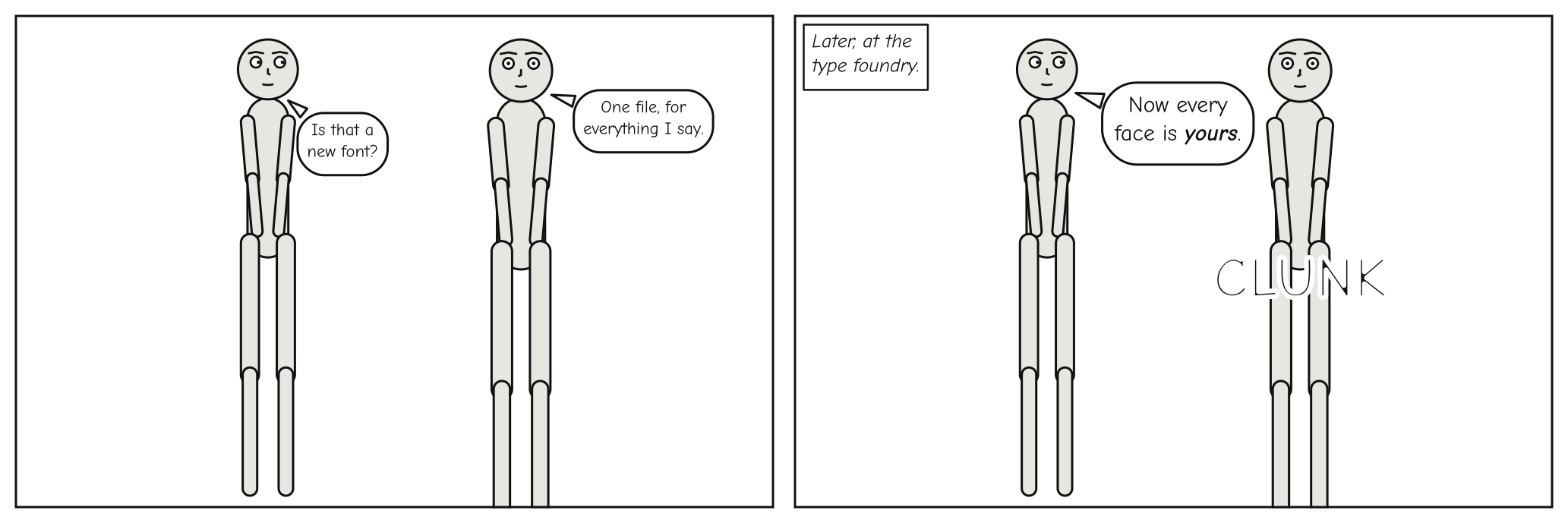
This document letters in Comic Neue, under the SIL Open Font License. Its four files are in
examples/gallery/fonts/;
save them in a folder fonts/ beside the document. The playground writes them there for you.
# Your own font: lettering in a face you supply, instead of the one Scenet ships.
#
# A font is always a file you name, never one installed on the machine: what the compiler
# measures has to be the same everywhere. Paths are relative to this document -- these are
# in fonts/, beside it, and the playground writes them there for you.
#
# `font:` may name one file, which then letters every face, as in the first panel. Or it
# names a file for each face, as in the second: `regular` for dialogue, `italic` for
# captions, `bold_italic` for a stressed word, `display` for sound effects. The face is
# Comic Neue, under the SIL Open Font License, which is in fonts/OFL.txt.
#
# The second panel also sets its own type size. Written there, `size` letters that panel
# alone; written beside `panels:`, it would letter every panel.

panel: {size: [1000, 650]}
camera: {shot: full_shot}

cast:
  alice: {reference: alice, at: left_third}
  bob:   {reference: bob,   at: right_third, facing: left}

staging:
  - alice left_of bob
  - alice looking_at bob

panels:
  one-file:
    lettering: {font: fonts/ComicNeue-Regular.ttf}
    script:
      - say: {by: alice, text: "Is that a new font?"}
      - say: {by: bob, text: "One file, for everything I say."}

  four-faces:
    lettering:
      size: 30
      font:
        regular: fonts/ComicNeue-Regular.ttf
        italic: fonts/ComicNeue-Italic.ttf
        bold_italic: fonts/ComicNeue-BoldItalic.ttf
        display: fonts/ComicNeue-Bold.ttf
    script:
      - caption: {text: "Later, at the type foundry.", kind: locale}
      - say: {by: alice, text: "Now every face is _yours_."}
      - sfx: {text: CLUNK, from: bob, size: medium}
scenet build own-font.scene.yaml
wrote own-font.one-file.svg
wrote own-font.four-faces.svg
Capitals#
Comics are conventionally lettered in capitals, and Scenet sets exactly what you type. It does not uppercase for you, because doing it well is not a case conversion: the pronoun “I” takes a crossbar that every other capital I does not. Write in capitals if you want them; Capitals are yours to set says why.
Sound effects#
An sfx line letters a sound, exactly as written, in
the display face, with no balloon:
Key |
What it does |
|---|---|
the sound, as written: no exclamation mark is added |
|
the actor it comes from, which it is placed near |
|
a zone, on its own or as a pull on a sound |
|
|
|
turned clockwise, from -45 to 45 degrees |
|
the line of letters bent, from -120 to 120 degrees |
|
outline only, so the art shows through |
Save the panel at the top of this chapter:
# Sound effects: letters that are part of the picture.
#
# `- sfx:` letters a sound in the display face, Bangers, with no balloon. It goes near
# the actor it comes `from:`, or in the zone it prefers, chosen by candidate scoring like
# everything else -- never at a coordinate -- and it never covers a face. It can turn,
# bend along an arc, and be `hollow`: all outline, so the art shows through.
#
# It takes its turn in the script's reading order, but sits where the sound is. Balloons
# pay to cover it, so they settle around it; nobody moves for it. No exclamation mark is
# added: sound effects are not exclamations.

panel:
  size: [1200, 800]
  margin: 20

camera:
  shot: full_shot

cast:
  alice: {reference: alice, at: left_third}
  bob:   {reference: bob,   at: right_third, facing: left, pose: arms_crossed}

staging:
  - alice left_of bob

script:
  - sfx: {text: KRAK, from: bob, size: large, rotate: -14}
  - say: {by: alice, text: "What was that?"}
  - sfx: {text: tok tok tok, prefer: top_right, size: small, arc: 30}
  - sfx: {text: WHOOSH, from: alice, size: medium, arc: -40, hollow: true}
  - say: {by: bob, text: "Nothing. Go back to sleep."}
scenet build sounds.panel.yaml
wrote sounds.svg
A sound from somebody and pulled to a zone sits by its source, on the side you asked for:
# A sound pulled toward a zone.
#
# A sound effect `from:` somebody is placed near them. Give it a `prefer:` too and the zone
# pulls it: still by its source, but on the side you asked for. With no source at all,
# `prefer:` alone says where it would like to sit.
#
# `rotate` turns it clockwise, in degrees from -45 to 45: positive leans its top to the
# right, negative to the left. Like everything about a sound, it is applied to the letters'
# outlines, so it comes out the same in every viewer.

panel: {size: [1200, 800]}
camera: {shot: full_shot}

cast:
  alice: {reference: alice, at: left_third}
  bob:   {reference: bob,   at: right_third, facing: left, pose: arms_crossed}

staging:
  - alice left_of bob

script:
  - sfx: {text: RING RING, from: bob, prefer: top_right, rotate: 12, size: large}
  - say: {by: alice, text: "Your phone."}
  - sfx: {text: tap tap, from: alice, prefer: bottom_left, rotate: -10, size: small}
  - say: {by: bob, text: "Let it ring."}
What the compiler decided#
The breaks were scored, not just wrapped. The compiler wrapped each line at every width a run of its words could measure, and kept the block whose shape came closest to the one a letterer would choose. It measured with the font that draws the line, so what is measured is what is drawn.
Lettering is drawn as outlines. Every letter is written into the SVG as the shape of its glyph, so the picture looks the same in every viewer, with or without the font. A sound’s rotation and arc are applied to those outlines too.
A sound is part of the picture. It takes its turn in reading order, but sits where the sound is. Balloons pay to cover it, so they settle round it; nobody moves for it, and it never covers a face.
A face left out stands in. Name a regular font and no italic, and the captions are
lettered in the regular face: scenet build says so, in an
italic-stand-in note. With no bold_italic,
the bold-italic-stand-in note says
which face letters a stressed word instead. A font file that is not there is
font-file.
An underscore left open is a mistake. _told you stresses nothing, and is
unbalanced-emphasis:
cast:
  alice: {reference: alice}
script:
  - say: {by: alice, text: "I _told you it would rain."}
Try it#
How lines break: make the panel narrower,
size: [700, 850], and watch the long line rebreak.Emphasis: stress every word of a line.
Type size: set
lettering: {size: 40}.Your own font: delete the
italicline, and read the note.Sound effects: the panel you built. Make the KRAK
hollow: true.A sound pulled to a zone: change
prefer: top_righttoprefer: bottom_right.
Check it#
scenet check sounds.panel.yaml own-font.scene.yaml
sounds.panel.yaml: ok
own-font.scene.yaml: ok
check makes sure every font file a document names is there and is a font, without
lettering anything: a missing one is
font-file, with the line and column it is named
on. scenet check --deep letters every line as build would, and reports
a balloon that cannot be placed anywhere as
balloon-placement.
What you learned#
Write each line whole: the compiler breaks it, measured against the real font.
_word_stresses a word, in bold italic.lettering.sizesets the type size, for a panel or for every panel besidepanels:.lettering.fontletters in files you supply, one for every face or one per face.Capitals are what you type.
sfxletters a sound into the picture: from somebody or in a zone, sized, turned, bent or hollow.
Where to go next#
The next chapter, Faces and marks.