Export a panel’s staging for image models#
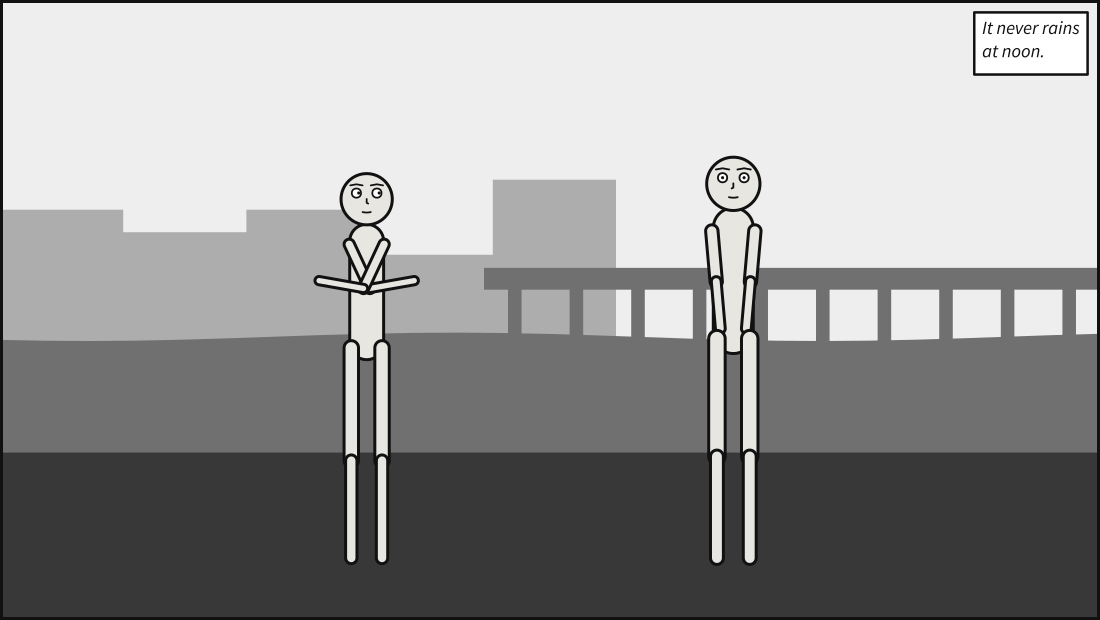
Scenet resolves what image generators are worst at — who stands where, how big, facing which way, at what shot — and draws it as a mannequin. When you would rather have a model paint the panel, hand it that staging in the formats spatially conditioned models already read: a pose, a box per figure, a depth map, a mask, and the structure of the scene.
No model runs in Scenet. Each export is one more emitter, reading Panel Core and nothing else, as deterministic and as explicable as the SVG. Whatever you feed it to afterwards is outside the pipeline, the way an artist tracing over the SVG is. Nothing is rasterised either: the exports are text, JSON and SVG, and turn into pictures with whatever you already use for SVG.
Build them#
scenet build examples/gallery/01-two-characters.panel.yaml --conditioning
Five files land beside 01-two-characters.svg:
File |
What it is |
Read by |
|---|---|---|
|
Each actor’s skeleton, OpenPose COCO-18 |
ControlNet’s OpenPose tooling: ComfyUI’s |
|
A phrase and a box per figure |
GLIGEN, and box-conditioned models after it |
|
Grey planes in painter’s order, white near, black far; floors recede |
ControlNet depth, once rasterised |
|
Each figure and backdrop mass in its own flat colour |
Regional prompting, inpainting per figure |
|
Camera, setting, cast and lettering, as structure |
Whatever writes your prompt |
A scene or a comic script gets one set per panel, named after each panel’s SVG. From Python:
from scenet import compile_source, render_conditioning

core = compile_source("""
camera: {shot: full_shot}
cast:
  alice: {reference: alice, pose: pointing}
  bob: {reference: bob, facing: left}
staging: [alice left_of bob, alice looking_at bob]
""").core

exports = render_conditioning(core)
files = dict(exports.files())
assert list(files) == [".pose.json", ".boxes.json", ".depth.svg", ".mask.svg", ".semantics.json"]
The MCP server’s render takes conditioning: true and returns the same
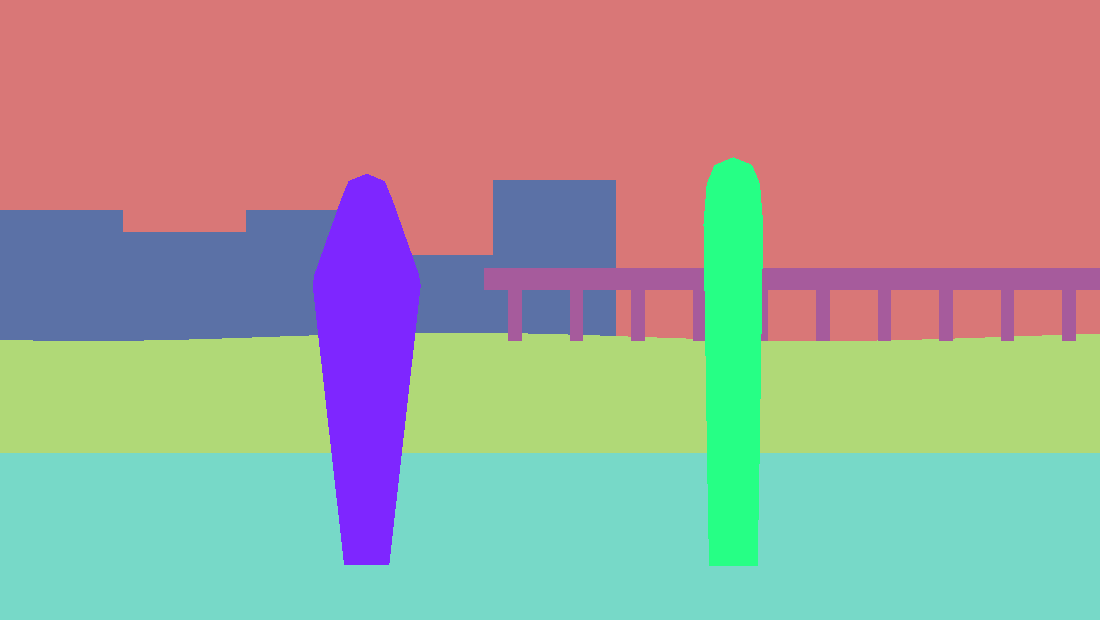
five per panel. The playground shows them: its
Depth, Mask, Pose, Boxes and Semantics tabs hold every panel’s, side by side under the panel’s
name, the pose drawn as OpenPose draws a skeleton and the boxes as rectangles labelled with their
phrase. Its Download menu offers a panel’s five files, or, for a document of several panels, a ZIP
holding each panel’s under the names build --conditioning gives them.

The pose#
people[] holds one person per actor, in Panel Core’s order, each 18 x, y, confidence
triplets in COCO-18 order (nose, neck, right shoulder, elbow, wrist, left shoulder, elbow,
wrist, right hip, knee, ankle, left hip, knee, ankle, right eye, left eye, right ear, left
ear) in pixels of a canvas canvas_width by canvas_height: the panel at one pixel per unit,
rounded up. A tool that wants fractions instead divides by the canvas size.
Left and right are the subject’s. Every Scenet body faces the reader, turned one way or the
other, and a body facing you has its right hand on your left. Scenet’s own joint names are the
other way about — shoulder_l is the shoulder on the screen’s left in the puppet’s rest pose —
so the export maps them per facing:
|
OpenPose right |
OpenPose left |
|---|---|---|
|
|
the |
|
the |
the |
Either way the subject’s right shoulder is on the reader’s left, so a model is never handed a figure turned away from you.
A point is 0, 0, 0 — as OpenPose writes a part it did not detect — when it is outside what the
panel draws (its frame, or a slanted tier’s outline: a medium shot has no knees), when the
puppet has no joint by that name, and always for the ears, which no puppet draws. root,
spine and head have no COCO-18 counterpart. Figures a picture draws were never posed and are
not in people.
The boxes#
import json

from scenet import compile_source, render_conditioning

core = compile_source("""
camera: {shot: full_shot}
cast:
  alice: {reference: alice, pose: pointing, expression: angry}
  bob: {reference: bob, facing: left}
staging: [alice left_of bob]
""").core

boxes = json.loads(render_conditioning(core).boxes)["boxes"]
phrases = [box["phrase"] for box in boxes]
locations = [box["box"] for box in boxes]
assert phrases == ["Alice, pointing, angry", "Bob"]
assert all(0 <= value <= 1 for box in locations for value in box)
Each box is [xmin, ymin, xmax, ymax] as fractions of the panel — phrases and locations are
what diffusers’ GLIGEN pipeline takes as gligen_phrases and gligen_boxes. An actor’s box is
its hull’s bounds, clipped to the panel; a figure a picture draws gets its body and face. The
phrase is the description’s own words for the figure, without where
it stands, which is the box’s to say.
Depth and masks#
Scenet is flat and orthographic: it has a painter’s order, not distances. So the depth map is flat grey planes in that order, each depth present one even step paler than the one behind it, the frontmost white. Black is nothing nearer than infinity: the paper, the sky, and a supplied picture, whose content Scenet never saw. This runs the opposite way to Scenet’s own backdrop tones, where far planes are paler, because a depth map is read white near.
A ground, a floor or a stretch of water is different: it runs from the reader’s feet to the horizon, and one flat grey would tell a model it is a wall at one distance, with the figures pasted in front of it. Depth models read relative inverse depth, and a flat ground seen through a camera has an inverse depth that grows in step with how far below the horizon it is seen. So each of those is a straight ramp, from its own step at the horizon down to the panel’s bottom edge; a ceiling is the same ramp running up to the top edge. The two ends are chosen to keep what the steps say:
At the horizon, the surface’s own step. It is never darker than its plane, so it is never behind anything the painter’s order puts behind it. Scenet stands every wall and building on the horizon line, so true depth there, black, would put the ground behind what stands on it.
At the edge, the step of the farthest figure, white when every figure is. No figure is ever darker than the floor at its feet. In the alley, where a wall in the foreground is white and Alice one step below it, the ground stops at her grey.
A ramp that would not get paler stays flat: a ground in the
foregroundplane is drawn over the cast, already a step above every actor.
Everything else keeps its flat step. A ramped region’s paint names its step as the fallback,
fill="url(#ramp-4) #bfbfbf", so a renderer that cannot resolve the gradient draws the step, and
reading a region’s grey from its fill reads its step either way. A Panel Core edited by hand to
set no horizon has its surfaces recede from their own far edge instead: a ground’s top, a
ceiling’s bottom.
Both maps are drawn on the pose’s canvas, one unit to a pixel, so every export is on one pixel grid: a panel of part units, such as one on a page, is not stretched, and what lies past its edge is black. Edges are crisp, so a rasteriser blends no two regions into a colour or grey that belongs to neither.
The mask fills each region in its own colour under the id the panel’s SVG gives it —
actor-alice, mass-m0, figure-ana — so the colour of each is read from the SVG itself. A
character keeps its colour across panels, unless another character in the same panel has the same
hue, in which case the later id (in sorted order) takes the next free one. The hue is one of 64,
from the id, so with four characters in a panel that happens about one time in ten: read the
colour from the semantics, whose actors and figures each carry their mask, or from the
SVG, rather than assuming it. A figure a picture draws takes the colour of the part
it plays. Masses take paler, less saturated colours, which no character’s can be. What each region is, a puppet or a kind of mass, is in the
semantics under the same id.
Both use the regions the solver used: an actor’s hull, a mass’s polygon, a figure’s body and face. Not the mannequin’s limbs: the export says where a character is, and the pose says how it stands. Marks and sound effects are drawn around a figure, not part of it, and are in neither; the semantics lists them.
The semantics, which is not a prompt#
Prompt dialects differ per model and change every few months, so Scenet hands over structure and
leaves the prose to you: the shot and angle, the place, hour and weather, each actor’s puppet,
pose, expression, marks, facing, whom they look at, their depth and their mask colour, every
figure a picture draws with its mask colour, and every balloon, caption and sound effect in
reading order with its box — DiffSensei’s dialog boxes. The description and each entry’s
label are Panel Core’s, the words accessible output reads; nothing is phrased twice.
Right to left, figures, pictures#
A panel read right to left exports the same pose, boxes, depth and mask as the panel read left to right: only reading follows
direction, never the scene. The semantics saysdirection, names the cast from the right in its description, and has the lettering where it went.Figures a picture draws have boxes, mask regions, and one depth plane in front of their picture — nothing orders two of them — but no pose and no camera: the artist drew and framed them.
Over a supplied picture, the picture is the far plane and the background of the mask. The semantics names the picture and says nothing of its place or hour, which are in it.
A panel drawn in colour exports the same pose, boxes, depth and mask as the panel in grey: a palette changes no value and moves nothing. The semantics says
"palette": "tinted", and says nothing of a panel inmono.
A whole page#
Each panel’s Core is compiled at exactly its frame’s size, so a panel’s units are the page’s,
shifted by where its frame is — and --core writes that as each page’s Page Core. A page-level
layout, as DiffSensei takes one, is the frames plus each panel’s boxes:
import json

from scenet import compile_book, render_conditioning

book = compile_book("""
cast: {alice: {reference: alice}, bob: {reference: bob}}
panels:
  one: {staging: [alice left_of bob]}
  two: {camera: {shot: close_up}}
pages: [{tiers: [{panels: [one, two]}]}]
""")

page = book.pages[0]
layout = []
for frame in page.frames:
    core = book.panels[frame.panel].core
    for box in json.loads(render_conditioning(core).boxes)["boxes"]:
        xmin, ymin, xmax, ymax = box["box"]
        layout.append(
            {
                "panel": frame.panel,
                "id": box["id"],
                "box": [
                    frame.x + xmin * frame.width,
                    frame.y + ymin * frame.height,
                    frame.x + xmax * frame.width,
                    frame.y + ymax * frame.height,
                ],
            }
        )
assert {entry["panel"] for entry in layout} == {"one", "two"}
A slanted tier’s frame has an outline, and an inset a clearance, both in page units.